The 2025 Salmon Survey has come to an end. Updates from the season are below, including our final salmon count. If you have any questions about the salmon survey, or would like to be added to our volunteer announcement for 2026 please reach out to Piper, our Salmon Survey Coordinator.
2025 Salmon Counter
Live Fish Observed
100
Dead Fish
0
Redds
0
A note about the high count of live salmon observed: This is the total number of fish observed by teams since the beginning of the survey. This does not mean that there are over 100 fish in the streams. The highest amount of fish observed in one day was between 23 – 32 fish. The average number of fish seen daily is about 4 – 6 fish. The live fish observed includes fish that are most likely being counted more than once.
We have reached the end of our CSI Salmon Suvey for 2025. This has been such an unusual survey season. We almost ended at Week 7 but in the last day 3 fish swam into the stream system. So we spent the past week searching for more fish – both alive and dead – but found none.
So why has this been such an unusual year? It comes down to a couple of factors but most importantly the weather. We just weren’t getting the consistently wet and cool weather to welcome the fish home. We’d have intense downpours followed by 5-6 days of sunny, clear skies. These downpours didn’t help the fish enter the stream, instead it washed fish back into the Sound, and uprooted any redds that were made. Surveyors described turbid, fast, high water ripping through the stream beds, and then the next few days after a storm surveyors reported zero fish in the streams.
This trend of lower fish counts wasn’t unique to Miller-Waker, it was also seen in other stream systems including the chum run at Carkeek Park in North Seattle. They were expecting ~3,000 fish but the number of chum to arrive was closer to 300.
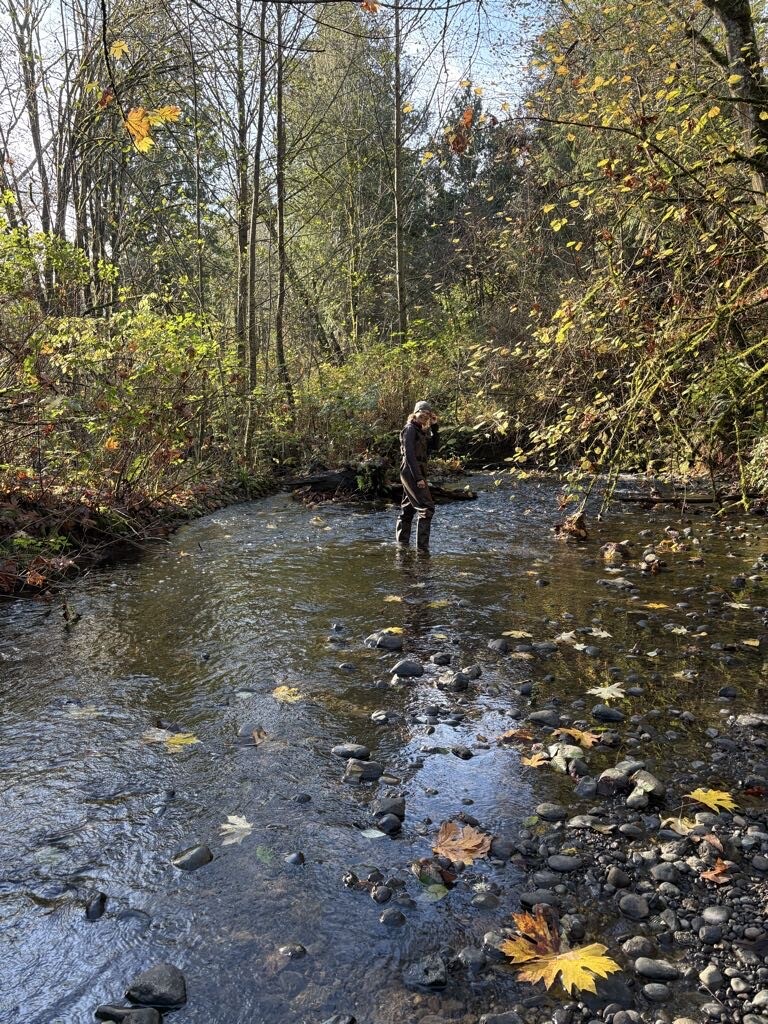
A member of the Wednesday Survey Team on a sunny & clear day during this mild Fall. Photo by Nicole B.
The Final Survey Numbers
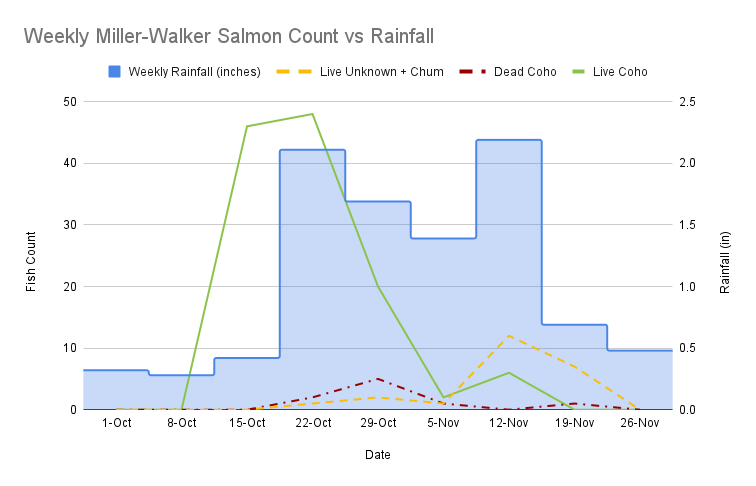
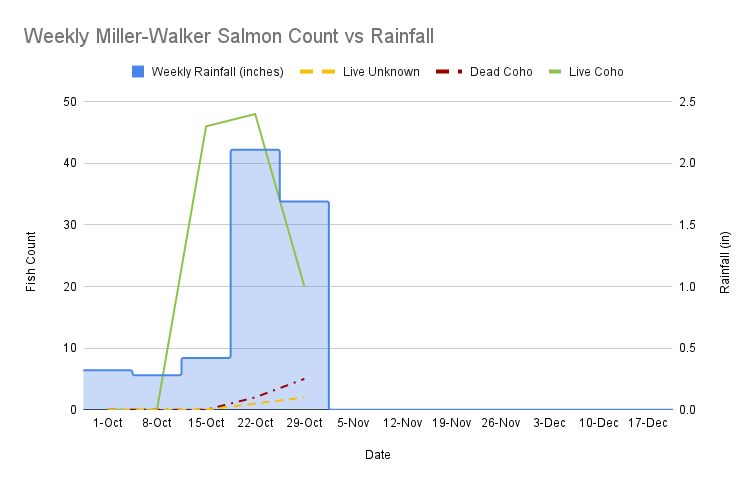
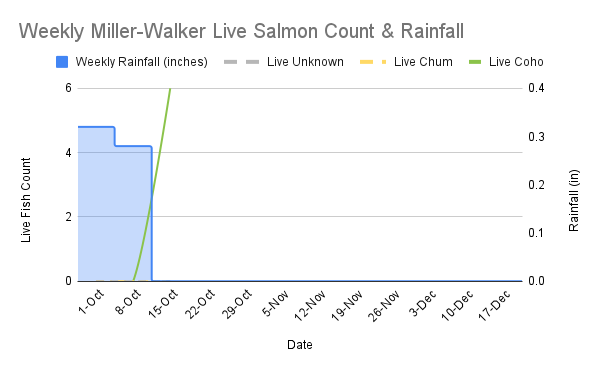
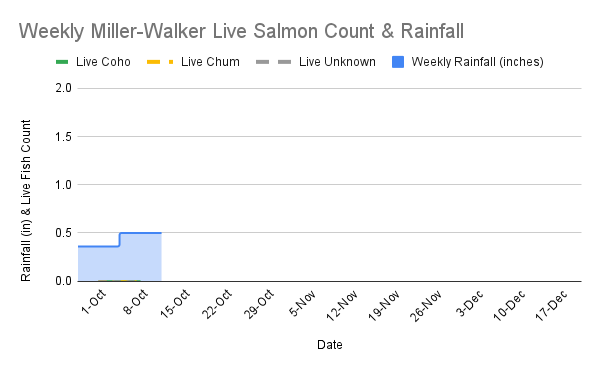
Looking at our final numbers for the 2025 Salmon Survey we saw two peaks in fish returning:
The first was in mid-October with the most fish seen in 1 week totaling 49 (48 coho and 1 UNK)
The second peak was in mid-November with the most fish observed in 1 week totaling 18 (9 UNK, 6 coho, 3 chum).
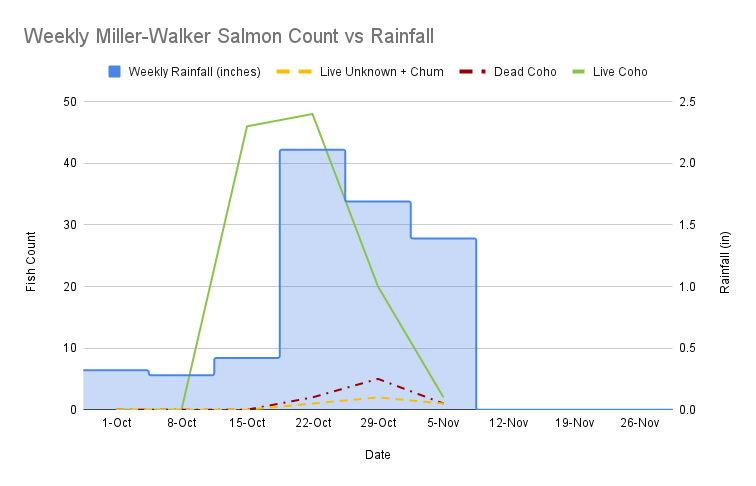
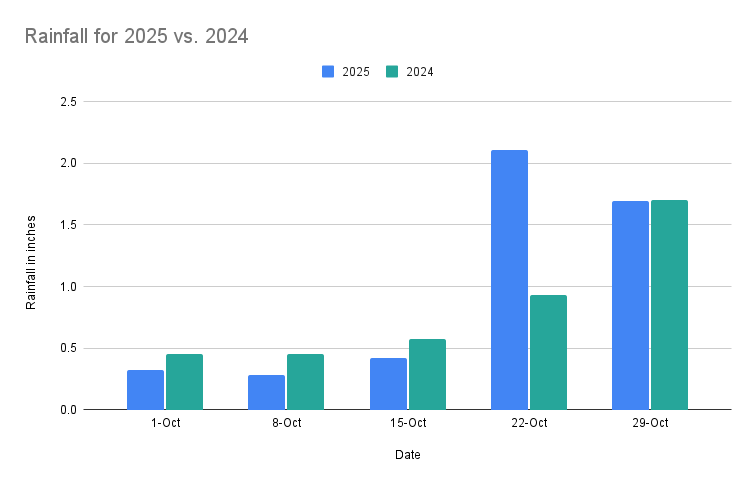
We can see we started off with a pretty dry start to the season, with enough rain to pull fish into the Duck Pond on Lower Walker. You can see that both bumps in fish correspond to the largest amount of rainfall in a week. This further highlights the importance of fresh rainfall with salmon returns.
Why are there so few dead fish reported?
At the beginning of the season the majority of coho observed were in the Duck Pond, waiting for more rain to fill up the streams. These fish were easy to pick off by our local predators, most notoriously the family of river otters that gallivant throughout the Lower Walker and Lower Miller system. We also had sightings of herons pulling fish from the stream, and even a coyote sighting. With only a handful of fish retuning to the streams at a time, any fish hauled out of the stream by our vibrant predators left very few signs of dead fish for our surveyors to count. The high flow storms we had were also responsible for washing out any dead fish to the Sound. (These storms are also why it was difficult to locate redds.)
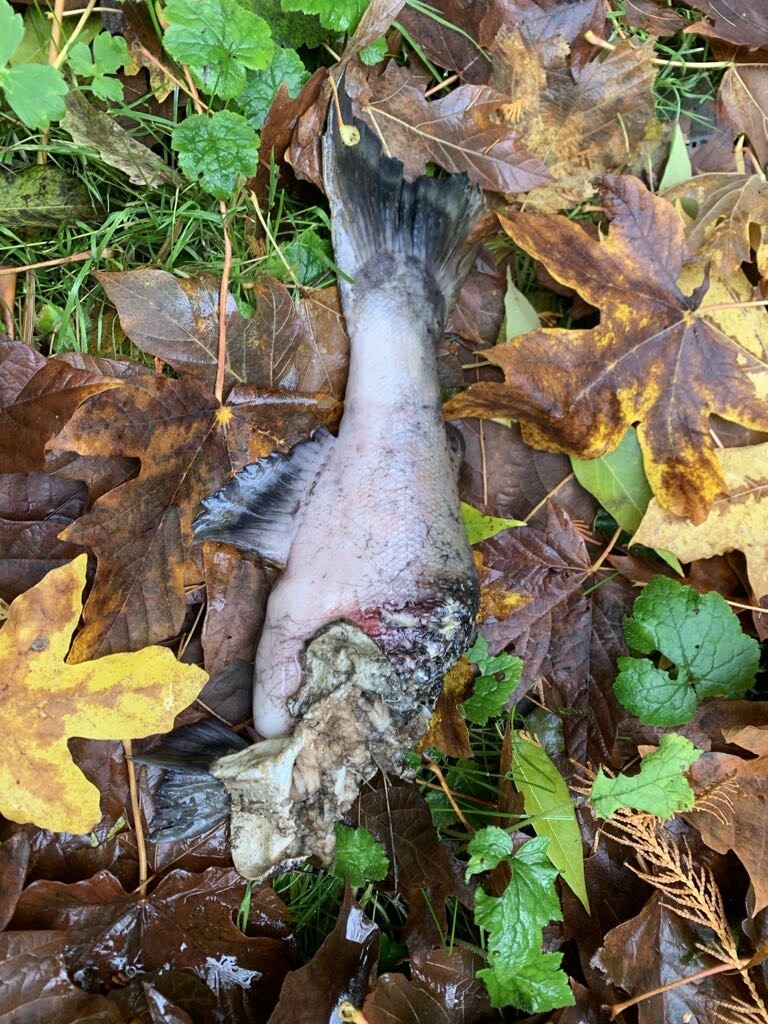
A photo of a partially eaten male coho found along Upper Walker. Photo taken by Carly W. & Jeff B.
Thank You to Our Incredible Volunteers & Normandy Park Residents!
We could not do this survey without the diligent work of our wonderful CSI Salmon Surveyors and the participating neighbors who provide access to the streams! Survey teams were out in the streams every day from October 1 – November 30th, working over 330 hours, interacting with dozens of community members and several school groups. Thank you all so much for all time and effort you put into the survey each year. I am so grateful to get to work with you and am looking forward to another salmon season together in 2026.
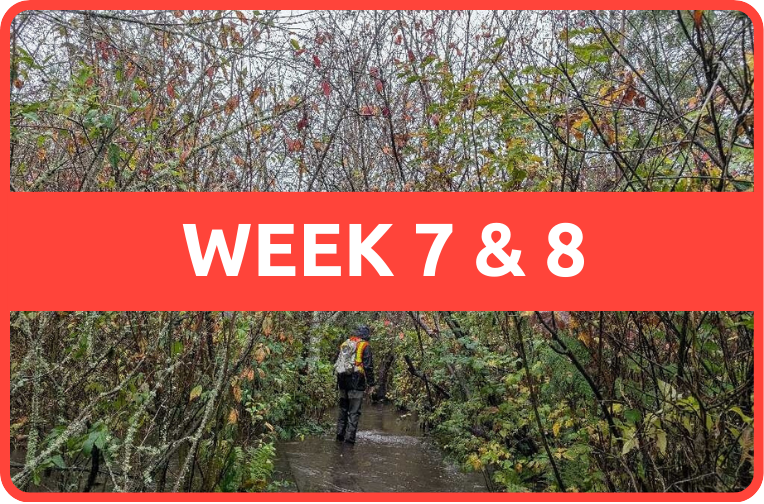
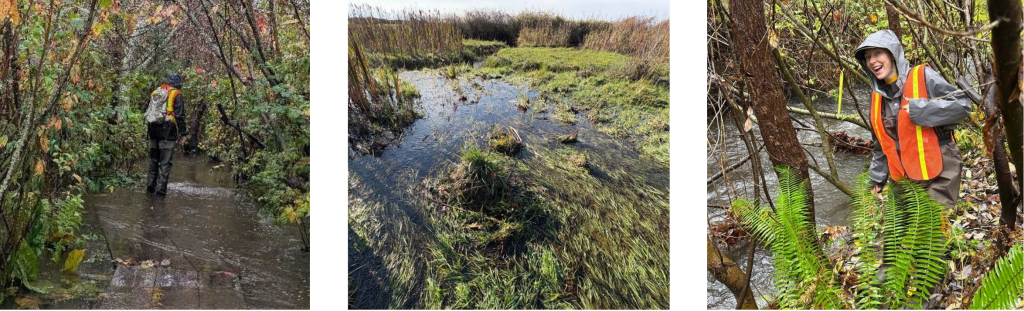
From Left to Right: Friday Team A wades through the flooded boardwalk along Lower Miller (Photo by Anthony H.); The estuary filled with rain water along Lower Miller and Walker (photo by Dawn N,); Thumbs up from the Thursday Team A (photo by Carol B.)
We’ve been hearing a question a lot this week: “Where are the salmon?”
With only 3 live salmon spotted, and 1 dead salmon collected, there has been a dramatic decrease in fish sightings. This is in part due to our erratic weather systems: warm, sunny days followed by a day or two of intense rain with flows strong enough to wash the fish out of the streams.
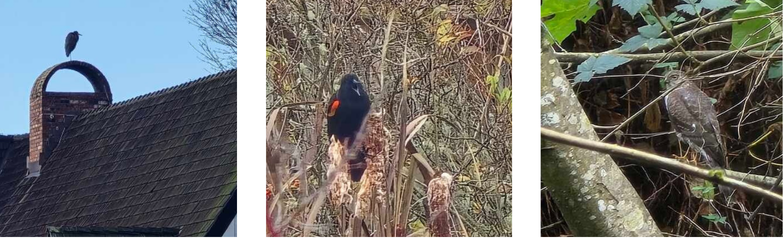
While the fish have been absent the bird sightings have been incredible: from eagles to sparrow hawks; grumpy herons to boisterous red-winged blackbirds.
Our data is trending downward, with no sign of the chum yet. We’ll see what the next couple of weeks hold for our salmon. There is still time for a second wave of fish.
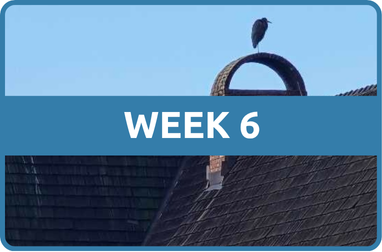
From Left to Right: A heron perches on a nearby roof; a red-winged blackbird calls in the estuary; a sparrow hawk sits camouflaged in the woods (photos by Kiki B.)
Coho & Chum Identificaiton
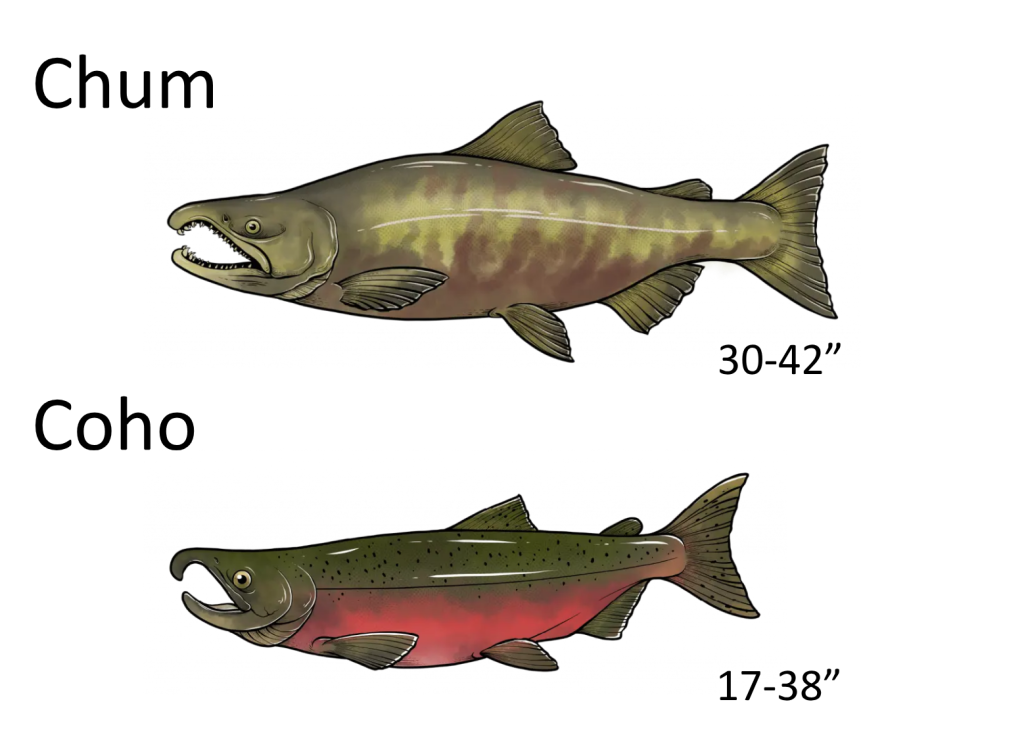
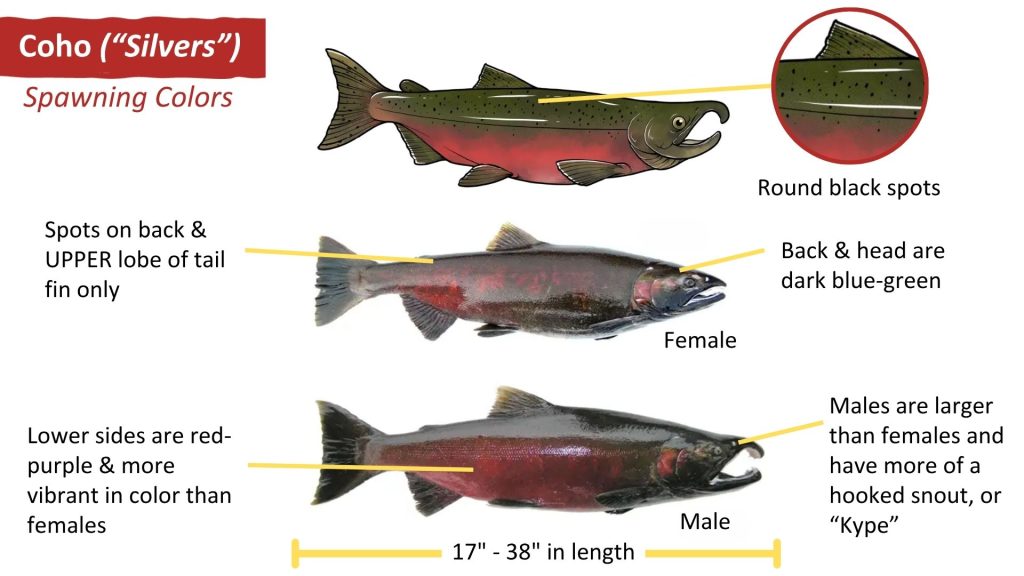
We’re pretty used to spotting coho in the stream by now, with their spots along their dark blue-green backs, dorsal fins, and tails. Males and females can sport the red-purple color, with males more vibrant than females. These fish are smaller then chum, clocking in at 17-38 inches. At Miller-Walker Creeks this year our dead coho have an average length of 23 inches.
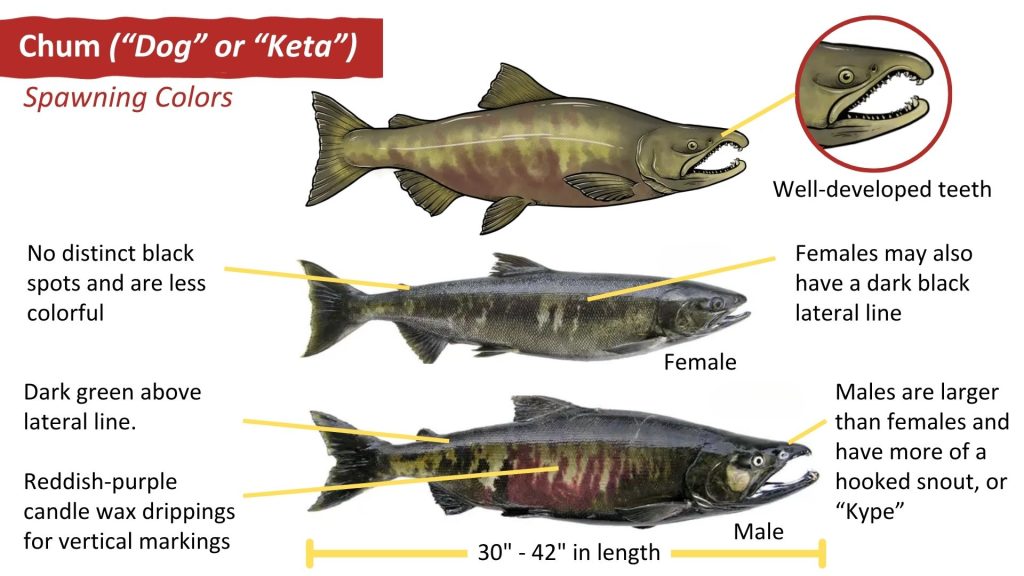
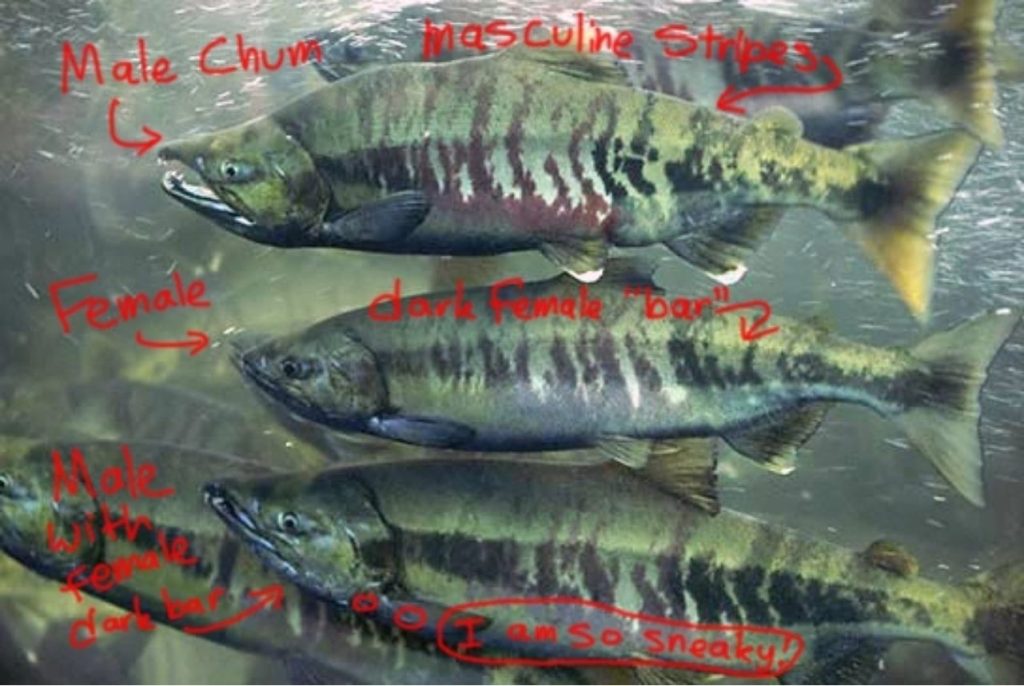
Our chum are larger, with dark green/brown and olive scales with reddish-purple candle wax drippings along their sides. These tiger stripes of color are more prominent on the males, although females can have them as well – just less distinguished. Females male also have a dark bar that runs along their lateral line. The males will sport large, well-developed, teeth, similar to a small canine. They use these teeth to bite and grab at other males when sparring over a female.
You may notice though that nature doesn’t always follow the strict identification rules. On the left you’ll see two male chum, and one female chum. The top male shows the distinguished candle wax drippings or tiger stripes of reddish-purple, while the male on the bottom sports a more distinguished black stripe along the lateral line, similar to the female chum in the middle. However, both males have distinctive kypes, or snouts, with large teeth and eyes. They are also physically larger than the female chum. She differs not only in size, but she also has a more rounded head shape with teeny tiny teeth and a smaller eye.
Now that you know a little bit more about how to identify coho and chum, keep an eye out for these two different salmon species at Miller and Walker Creeks!
While this hasn’t been the best week to see the salmon, this has been a great week for water. We had a couple of atmospheric rivers pass through, with more projected to be on the way, and King Tides starting November 7 – 9.
For areas of the streams where it appears fish may not be able to pass, these higher water levels will help fish navigate these obstacles. One of these “obstacles” is the beaver dam on Lower Miller. But what looks like an obstacle to us, is actually just a fun navigation adventure for fish. Iris Kemp and I connected with folks from King County and Beavers Northwest this week to get an update on this massive dam. The big takeaway is that there are still plenty of side channels around this dam for fish to navigate, and a reminder that coho are agile and strong, and are used to maneuvering around beaver dams. They’ve been doing this work for thousands of years and their bodies are built for athletic movement. And their hard work has paid off as coho are now entering into Lower Miller and have been seen by our survey teams up to the fourth Footbridge next to The Cove Clubhouse.
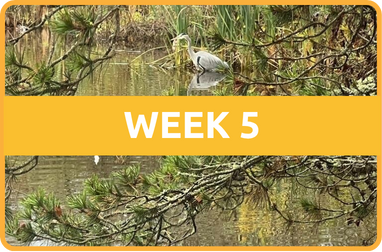
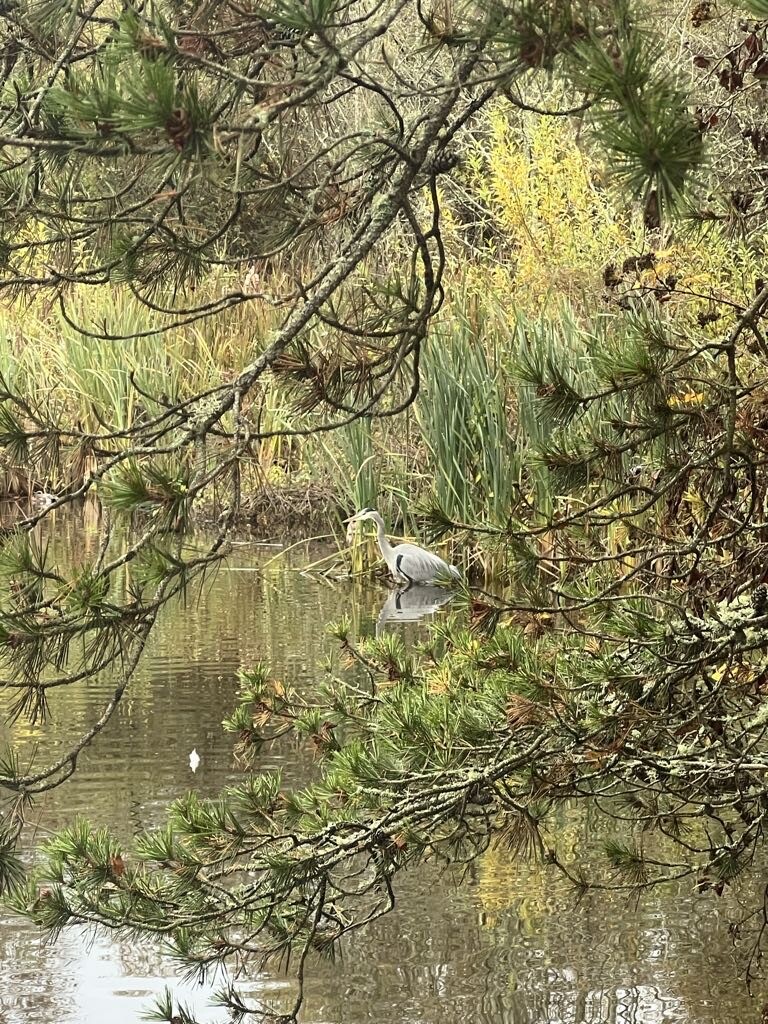
A heron fishing in Lower Walker, photo by Anthony & Bryna
Salmon Counter - Week 5
Live Fish
100
Dead Fish
0
Redds
0
Wait, what is a King Tide?
We heard from Iris Kemp earlier this week that King Tide season is upon us. She reached out with the following information:
“King Tides occur in winter when the gravitational forces of the sun, Earth, and moon are aligned, resulting in the highest predicted high tides of the year. Other King Tide periods this winter in King County are Dec 6-8 and Jan 4-6 (see this schedule for times and predicted tide heights). If you’re at the Cove during a King Tide, consider taking a photo and uploading it to Washington MyCoast. You can submit the photo via the website or use their free phone app.”
The effects of king tides are often exacerbated by our fall storms. With thousands of gallons entering into the stream system during a storm, paired with a king tide, this leads to extreme and often dangerous flooding. And with climate changes, these events are predicted to become more severe along the coastlines.
Latest Data from Miller-Walker:
This year, volutneers are logging the location where they find any live, dead, or redds. Here’s the latest data visualized in the map above.
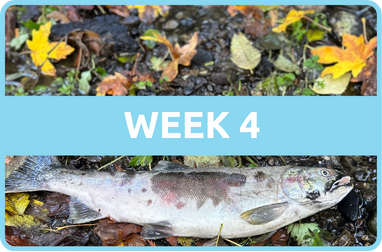
What an exciting week! Survey teams found coho beginning to move their way upstream on Lower Walker. Teams also found the first dead coho of the season – three female carcasses filled with eggs, and two salmon skins that had been fully devoured by the family of otters who live in the estuary. One skin was found at the confluence of Miller and Walker. The other salmon skin was observed along the bank of Lower Miller where the otters are able to devour their meals in peace. Why do we think this was the work of otters? Otters eat every bit of the salmon, except the skins, leaving a “skin tube” with the salmon head and tail often still attached.
A note about the high count of live salmon observed: This is the total number of fish observed by teams since the beginning of the survey. This does not mean that there are 91 fish in the duck pond. The highest amount of fish observed in one day is between 23 – 32 fish. The average number of fish seen daily over the past two weeks is about 6 fish. The 91 live fish observed includes fish that are most likely being counted more than once.
As fish continue to enter the stream, we’ll begin to observe more spawning behavior with females building their redds and males fighting for the chance to spawn.
Video by Ramona T. from the Wednesday Survey Team
Salmon Counter - Week 4
Live Fish
0
Dead Fish
0
Redds
0
What are "Redds"?
What is incredible about the 5 species of Pacific salmon is that each species utilizes different stretches of the stream for spawning. For our smaller stream system, coho and chum may compete for spewing habitat since it is fairly limited in these urban streams, increasing competition.
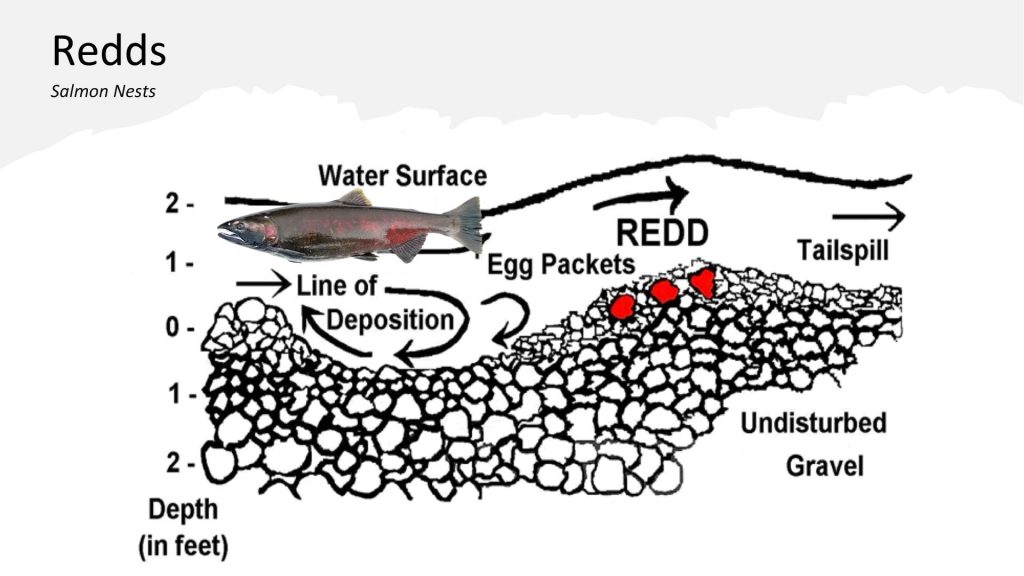
Females will choose a site for her redd, or nest(s), that is in moving water with gentle riffles, approximately two feet below the stream surface, and with a mixture of gravel that ranges in size from a thumbnail to silver dollar. This redd can contain more than one nest and she’ll be able to deposit a percentage of her ~3,000 eggs into one or more nests over several days of spawning. Her eggs can be fertilized by one male for all of her nests, or different males for each nest in the redd.
To the left is footage the Mid Sound team captured of two males sparring while a female coho digs her redd. You’ll also see the main male (he’s missing a chunk out of his tail), chase and nudge at a fresh male entering into the duck pond from the Sound. You’ll see the female turn on her side and slap her body up and down, working to remove sediment from between the gravel. Similar to a silty or clay-rich soil, oxygen cannot bubble through the tightly packed particles so the female clears this out to make room for her eggs. This space will keep the eggs from suffocating in the silt. Her undulating movement also dislodges smaller pieces of gravel that will move downstream, forming what’s called the “Tailspill” (see graphic above), washing away the finer sediment. She will keep working on her nest until it measures ~12 – 18 inches in depth.
As the female coho digs, her movements will signal to passing males that she is getting ready to lay her eggs. Males will proceed to fight off any other males, nosing them out of the way, chasing them, nipping at their tales, and raising their dorsal fins in an act to showcase how large they are. In between fights, the male will dance slightly behind the female, weaving his body over the lower half of hers. Part of this dance may also include moving alongside her and quivering, before returning to his courtship dance: weaving around her dorsal and caudal fins. In the video above you’ll also see him widen his mouth into a “gape” and nudging her in his display. The female will continue digging while the male dances and fights off the competition until she feels the nest is ready. She’ll then open her mouth to reduce the impact of the water’s current, helping her “crouch” deeper into the nest. When she does this movement it will signal to the male that she is getting ready to release her eggs. Side-by-side the spawning pair will quiver their tales and open their mouths wide a they release the eggs and milt (sperm) into the nest.
The female will then move upstream to build her next nest, the gravel from the second nest lightly covering the eggs in the first nest, protecting them form being washed away during water fluctuations. This digging process will continue until the female has released all of her eggs, and she will stay near her redd defending it from newer females looking for a nice home for their eggs. She’ll protect her redd until she grows weak and is swept downstream or until she dies. But this ins’t the end of the story.
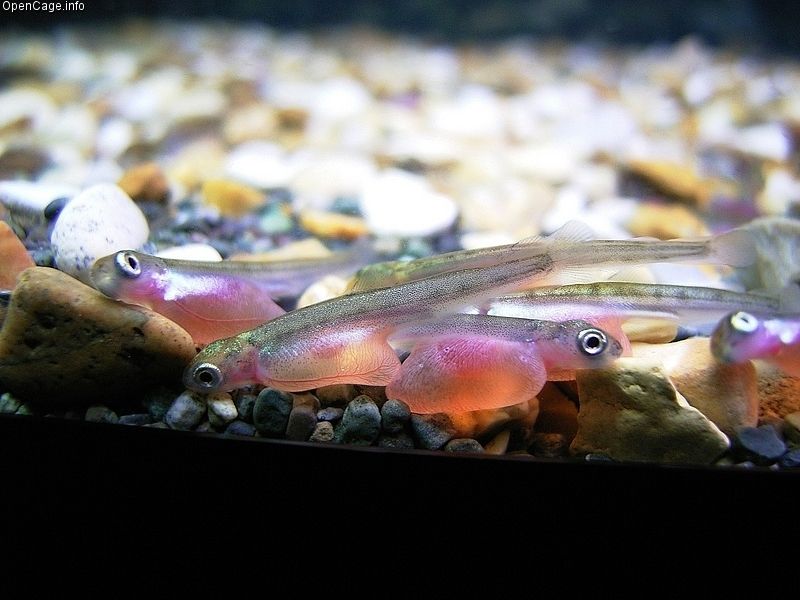
Alevin with their yolk sacs still attached to their abdomens
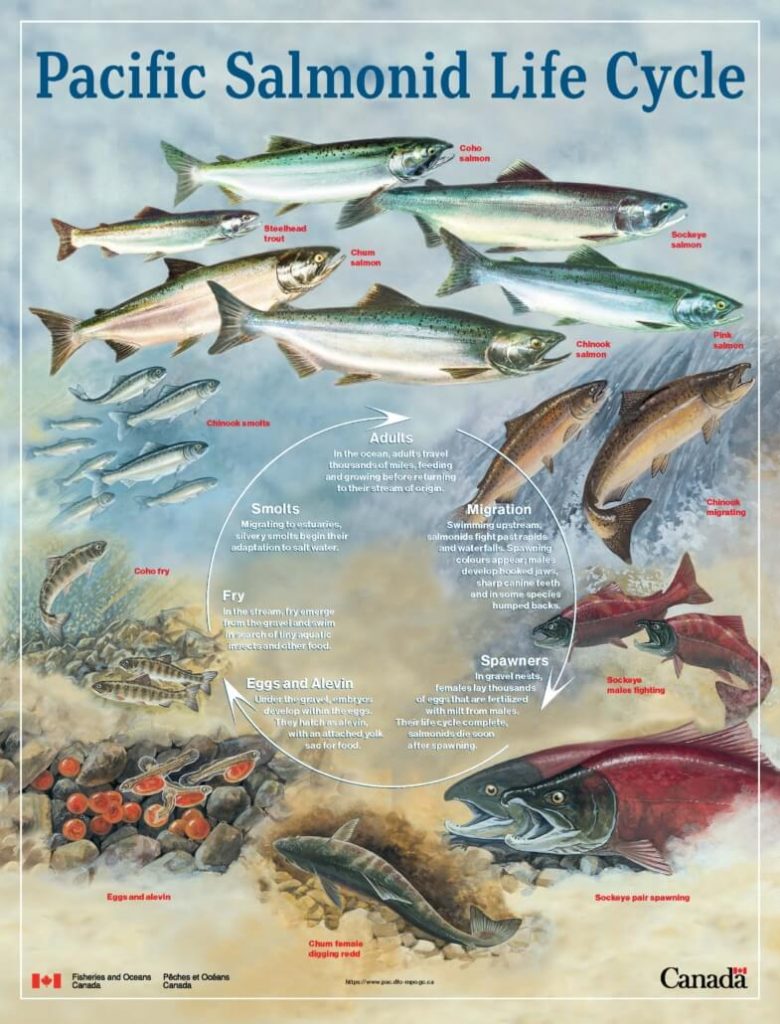
Her eggs will hatch over the next few months, emerging as alevin with their yolk sacs still attached the their abdomens. After the yolk sac is absorbed the alevin will morph into fry, spending the first year of their lives in the streams. They’ll spend this year foraging and growing to be big enough to venture out into the Sound as smolts. Here they will live for the next 2-4 years before returning to their home streams.
This development process is why other species, like the beaver, are so important to the salmon’s survival. Turbulent flows can push fry out to the Sound too soon, or can suffocate them with too much sediment washing off from nearby homes and roadways. As we learned last week, the beaver dams slow the water flow and reduce turbidity, creating healthier steam systems for the young fry. More fry surviving to adulthood, allows this incredible life cycle to continue.
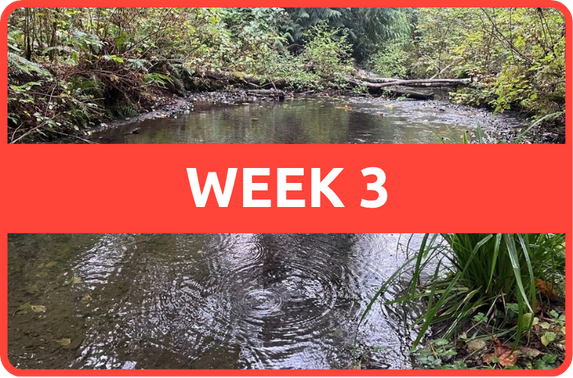
Week 3: October 15 – 22, 2025 We’re seeing more and more coho entering into Lower Walker, with our survey teams this weekend counting over 32 fish in the duck pond, and our Tuesday team finding the first redd directly below the footbridge by the duck pond. But why aren’t these fish traveling further upstream? There are actually several answers to this question. To help discover one of these answers I hopped on a call with a fish biologist who works on the salmon survey at Carkeek Park. Her first question was, “Are most of the fish in the pond male or female?” Turns out, we have more males than females. Females are present, including the female who is currently digging her redd under the footbridge, but they are outnumbered by males. Without females journeying upstream and releasing eggs, males will stay circling. Just like salmon are able to smell their way home, males are able to smell females upstream and their scent encourages males to journey forward. No females = No need to waste precious energy traveling upstream.
Another answer is rainfall. With the limited amount of rainfall we’ve had, there just isn’t enough water in the streams yet for adult fish to feel safe to travel beyond the pond. But you may be wondering, “If there isn’t enough water in the streams, how did the fish make it to the duck pond?” There are actually two answers. First answer: the tides. High tides allow water to flow up the mouths of streams, temporarily raising the water so that fish are able to enter into stream systems. But when the tide lowers, these streams can experience low water levels, sometimes being reduced to a small trickle during droughts. But there is a powerful engineer who is helping create some truly spectacular salmon habitat. This celebrity guest is: The Beaver.
Salmon Counter - Week 3
Live Fish
0
Dead Fish
0
Redds
0
Prior to European settlement in the United States, there were estimated to be ~400 million beavers, but they were trapped to near extinction for their furs and scent glands (that smell like vanilla). Beaver are the largest rodent in North America, and are responsible for creating lush, green forests, and meadows with rich, fertile, soils that became ideal farmland.
Beaver are quintessential to the water cycle, helping store millions of gallons of water, replenishing the water table, and combatting forest fires through pockets of wet pools. Today, there are only ~10 million beaver remaining in the U.S., and they are often labeled as a “nuisance critter” because their dams can cause flooding to nearby homes built along rivers or streams. But these rodents are incredibly helpful at reducing widespread flooding, combating climate change, and helping to save the Pacific Salmon – and beavers and humans can work together to coexist peacefully.
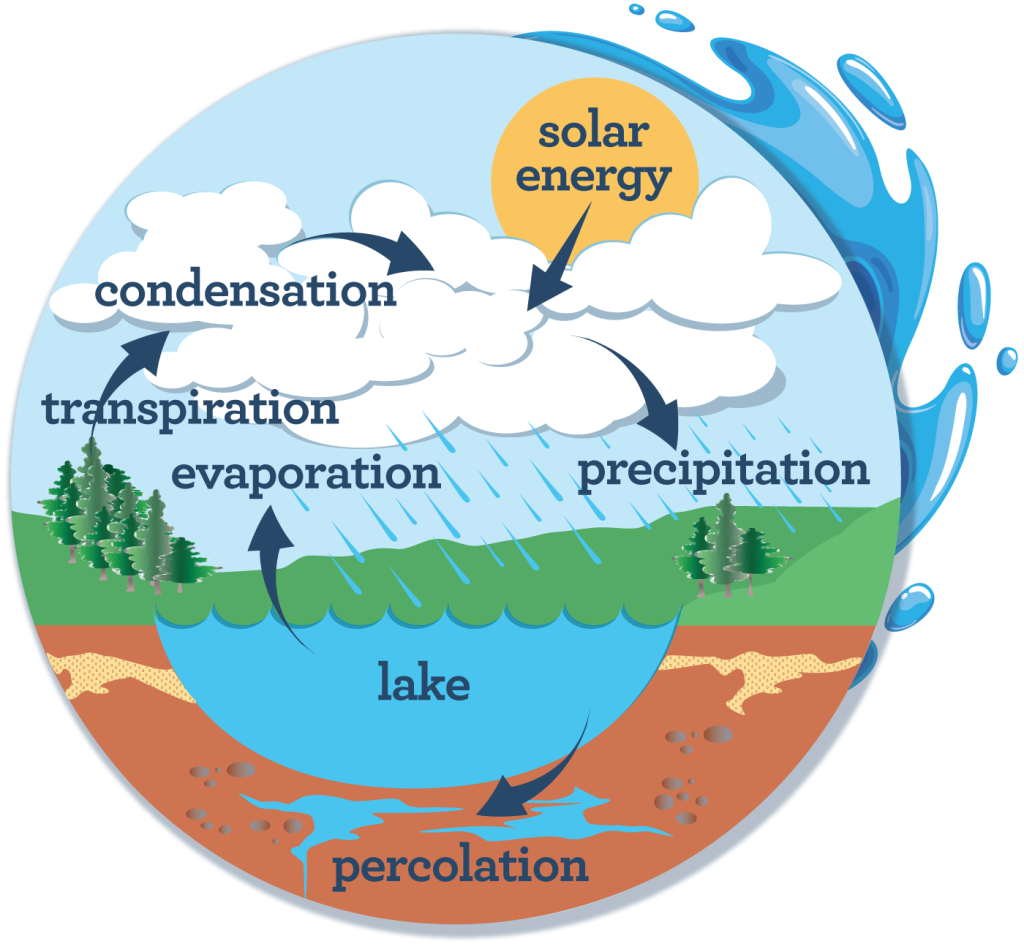
Urban runoff not only carries pollutants, but also a large amount of fine sediments, and a crushing flow of water that has the power to completely rearrange stream systems. Sediment is deadly to salmon eggs that need cold, clear, clean, and oxygen-rich water to survive. When eggs are covered with fine sediments from our roadways, reducing oxygen flow, the eggs suffocate and die. Water flow in urban streams can be powerful enough to scour out the bottoms of streams, uprooting salmon redds, flushing away eggs and alevin, and destroying the homes of the aquatic bugs salmon feed on. This extreme flow is due to stormwater water bypassing a critical step in the water cycle: percolation. Percolation is when precipitation is able to percolate through soils, and other pervious surfaces, into the water table. In urban systems, the majority of the ground is covered with impervious surfaces like roads, sidewalks, and roofs. This allows water to skip percolation and instead gush down into streams at alarming rates.
Graphic from WaterMatters.org
The Urban Beaver: A Stormwater Management Expert
Beaver dams in a stream system not only help reduce sediment loads in water, but also decrease deadly water velocity – creating the perfect habitat for salmon to thrive. Slower water cannot hold large amounts of sediment so with each dam stormwater hits, the water becomes clearer and slower. Juvenile coho, who spend the first year of their lives in streams and estuaries, need clear water to locate hiding places and to hunt, and need slower water so they aren’t flushed out into the Sound before they are big enough to survive open water. Beavers also introduce more large wood into the stream through trees they have felled which in turn capture woody debris floating down streams. These pieces of wood create pools in the streams which are essential hiding places for salmon of all ages to rest, and for juveniles to forage and hide.
But wait, if there are dams in the stream, how do salmon navigate the water without getting trapped?
Salmon and beaver have been evolving alongside one another for thousands of years, even before the first humans arrived 10,000 years ago. Young salmon are small enough to slip through the cracks in the dam, while adult salmon are strong enough to break through them, or swim around them. Along some dams, water may spill around the sides of the dam, creating small side channels that spawning salmon can easily swim up.
In the video below, chum salmon work together over the course of a couple days to make a small opening in the dam so they can pass through. What’s amazing about this opening is that it is below the surface level of the water, which means it does not create a cascading waterfall. When beaver hear the sound of rushing water over their dam, they will immediately fix this area to hold back water. This is because the deep water protects them from predators like coyotes, wolves, bears, and mountain lions.
Thanks to the beaver who lives in the Miller-Walker stream systems, and the humans who help beaver and people coexist, creating improved habitat for salmon in this urban area.
To learn more about urban beavers, and the incredible work they’ve been doing, check out Beavers Northwest. Or check out “Eager: The Surprising, Secret Life of Beavers and Why They Matter” by Ben Goldfarb from your local library.King County Libraries | Seattle Public Libraries
King County Public Libraries will also be hosting a screening of “The Freelance Beaver Detective: Tracking Urban Wildlife” by local filmmaker Kay D. Ray, featuring Pamela Adams.
To learn more, visit the freelancebeaverdetective.com and RSVP for the screening taking place: December 10th, 6pm – 8pm, at the Skyway Library: 12601 76th Avenue S, Seattle WA 98178.
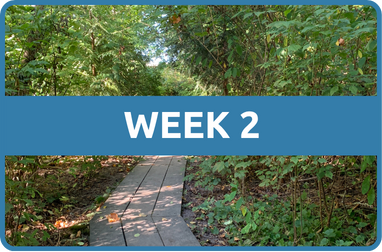
Week 2: October 8 – 15, 2025 The coho have returned! Members of The Cove found at least 6 salmon hanging out in the Duck Pond this week. Now is the time to start using those eagle-eyes to scout for salmon who may be resting or hiding in the pond, or along the banks of the streams – especially closer the mouth of the streams.
Despite minimal rainfall, the cooler temperatures are encouraging fish to return home. But these dry conditions mean that the water in the streams may be too shallow for fish to continue upstream. They’ll wait in pools near riffles of water where oxygen is plentiful before sprinting upstream during small rain events. This may also mean that with shallow water fish will be taking advantage of spawning areas closer to the mouth of the streams.
Video by Jim McLaughlin from The Cove
Updates for Volunteers: Now that the salmon have returned, please make sure you are filling out both Epicollect forms:
CSI Salmon Survey Notes
Salmon Survey Fish Log
There are also data forms in your clipboards if you run into any technical difficulties with Epicollect. Please take a photo of your completed data form and send to Piper via Slack or Email.
Salmon Counter - Week 2
Live Fish
0
Dead Fish
0
Redds
0
What's in store for the upcoming week?
Next week is boasting consecutive rainy days with cloud cover and temperatures in the high 50s. This will mean more fish may be taking advantage of this cooler system, entering the streams with each rain event. This may also mean that water may become murky and difficult to see into. Take time along the lookouts to watch for movement from fish navigating the waters. This also means that we may begin seeing coho suffering from Urban Mortality Runoff Syndrome (URMS) with these early rain events. If you see a fish suffering from URMS please take a video of the fish, send to Piper and update the Volunteer Folder (found in the Volunteer Portal) and contact Piper.
This time last year we had 3 Live, 2 Dead, and 0 Redds.
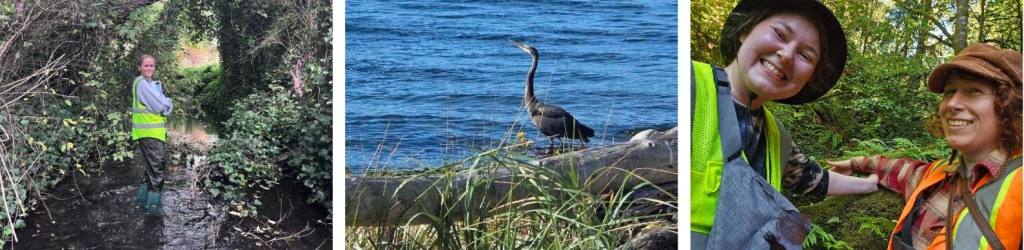
Photos L to R: Sunday Team B surveying at the Sewer District | A heron fishing in the Sound, photo by Kiki B. | Monday Team B enjoying a day in the streams
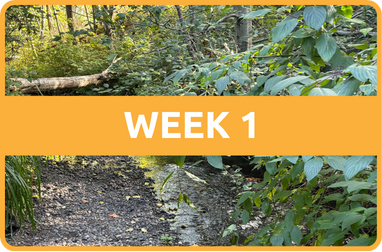
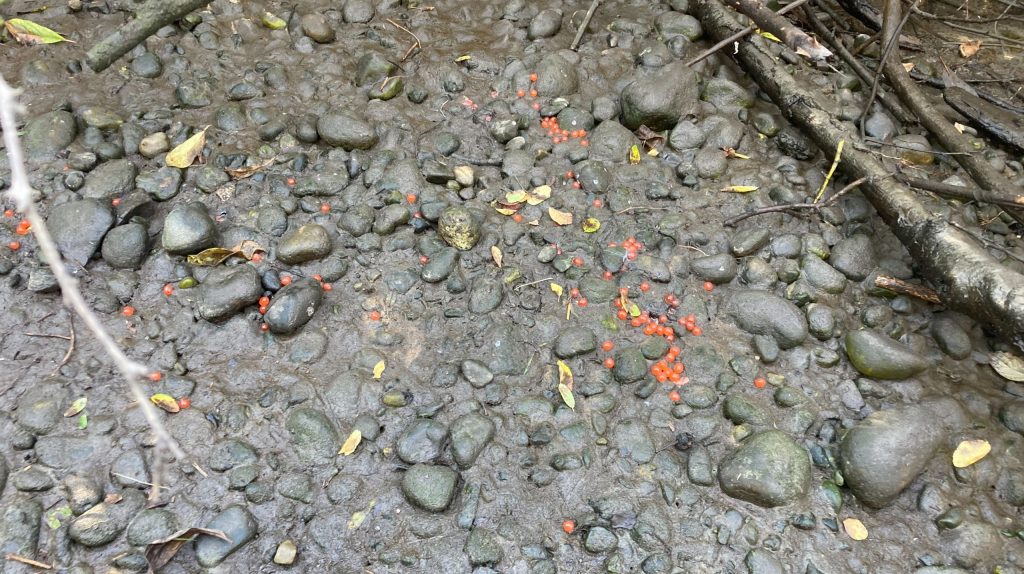
Week 1: October 1 – 8, 2025 We’ve had such a gorgeous start to October, with sunny skies and mild days. While it’s been lovely to soak up some extra days of sun, we’re waiting on more rain to arrive to fill up the streams, and welcome the salmon home. Rain is forecasted for next week so we may start to see some early spawners. We know the fish are in the Sound, with evidence found by the Monday Team this week: eggs on the bank by the Beaver Dam – which just happens to next to the trees where the Bald Eagle loves to perch.
Photo by Carly from Monday Team A
Updates for Volunteers: We’re updating the route order to make it easier and less time consuming to do the route (while avoiding NZ Mud Snails) The new route order: Lower Walker, Upper Walker, Lower Miller, Upper Miller
Salmon Counter - Week 1
Live Fish
0
Dead Fish
0
Redds
0
Why aren't there adult salmon in the stream yet?
Right now we just haven’t had enough rain to fill up the streams with a consistent flow of cold water. Our rain meter is only at less than an inch of rain in the first week. Wet and cool weather ahead will help welcome the salmon home, with coho typically returning mid-late October, and chum returning late October.
This time last year we had 1 Live, 2 Dead, and 0 Redds.
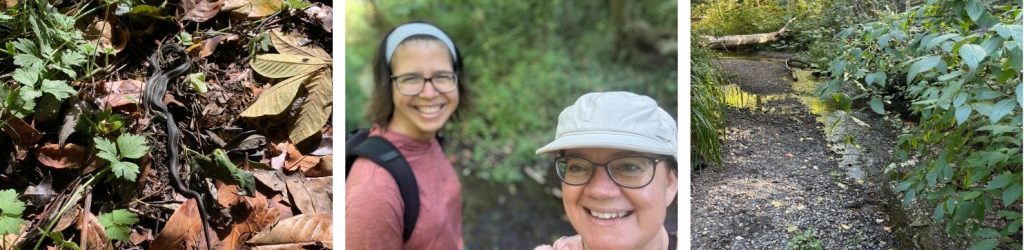
Photos L to R: Garter Snakes soaking in the sun | Wednesday Team B enjoying the mild weather | Low water in the creek due to lack of rain, photo by Nicole B.
Who are we seeing in the stream right now?
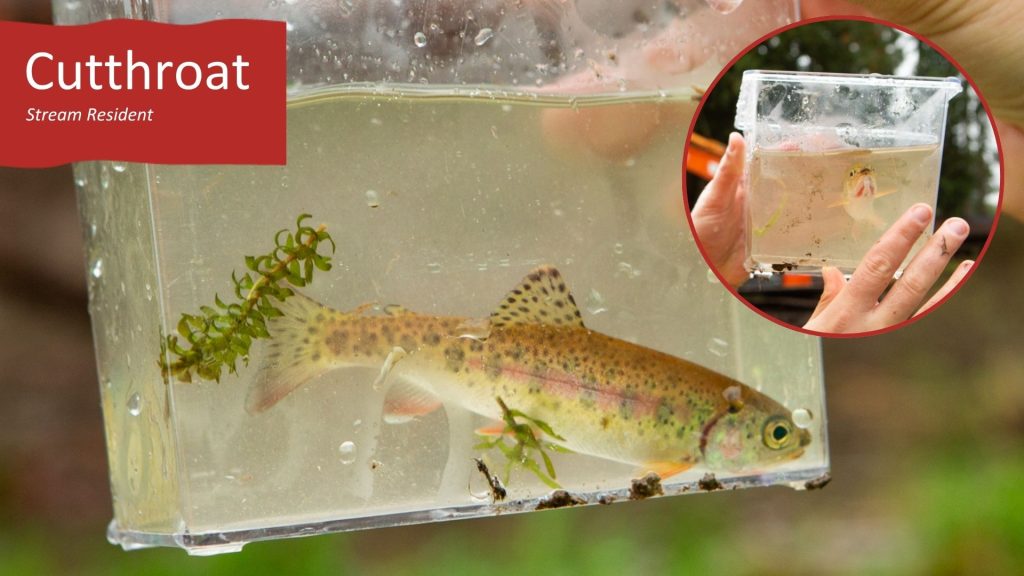
Volunteers have been reporting seeing tons of tiny salmonids (fish in the salmon family) in the stream. But who are they? In both Miller and Walker we have juvenile coho (oncorhynchus kisutch) who spend the first year of their lives in the streams. We also have resident cutthroat trout (oncorhynchus clarkii) – which are part of the salmon family. When you’re out in the stream, these fish are easy to confuse as they have similar markings that allow them to camouflage perfectly with their surroundings, and they dart quickly to shadowed areas for protection when they see us, or other predators, approaching.
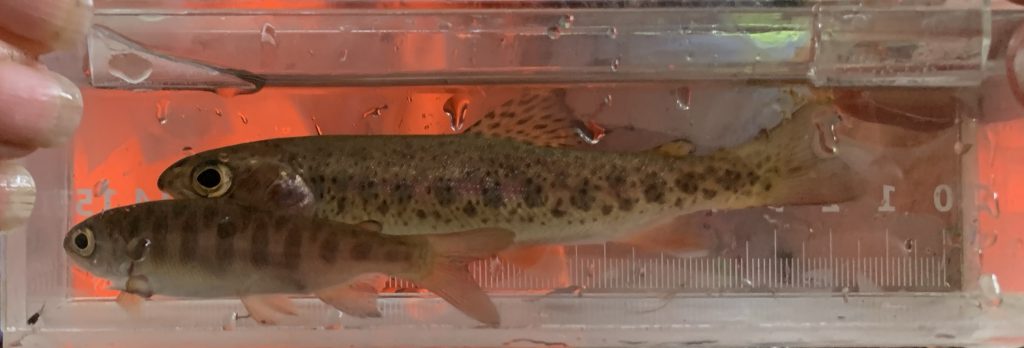
Above are a juvenile coho (front) and resident cutthroat (back) side by side for comparison. Listed below are the main distinguishing features between these two fish:
Juvenile coho are 2 – 3 inches in length and have par marks (dark, oval, markings) on their sides as well as their backs, with pale orange fins. Their anal fin is more sickle shaped (with a white stripe along the edge), and their mouth does not extend past their eye.
Cutthroat are 5 – 8 inches in length. They also have par marks along their lateral line, but they also have spots along their sides and backs, including up into their dorsal fin and down into their caudal fin (tail fin). They are pale yellow-green in color and have an iridescent sheen to their scales in sunlight. Their mouth extends past their eye.
Bonus Fact: Cutthroat get their gruesome name from the orange-red slits on the underside of their jaw.