Welcome to the CSI: Salmon Survey Updates
The 2026 Salmon Survey has begun. Updates from the season are below.
2026 Salmon Counter
A note about the count of “Live Salmon Observed”: This is the total number of fish observed by teams since the beginning of the survey. This does not equal the total number of fish in the streams.
2026 Survey Updates
Week 7 & 8
Coho & Chum Identificaiton
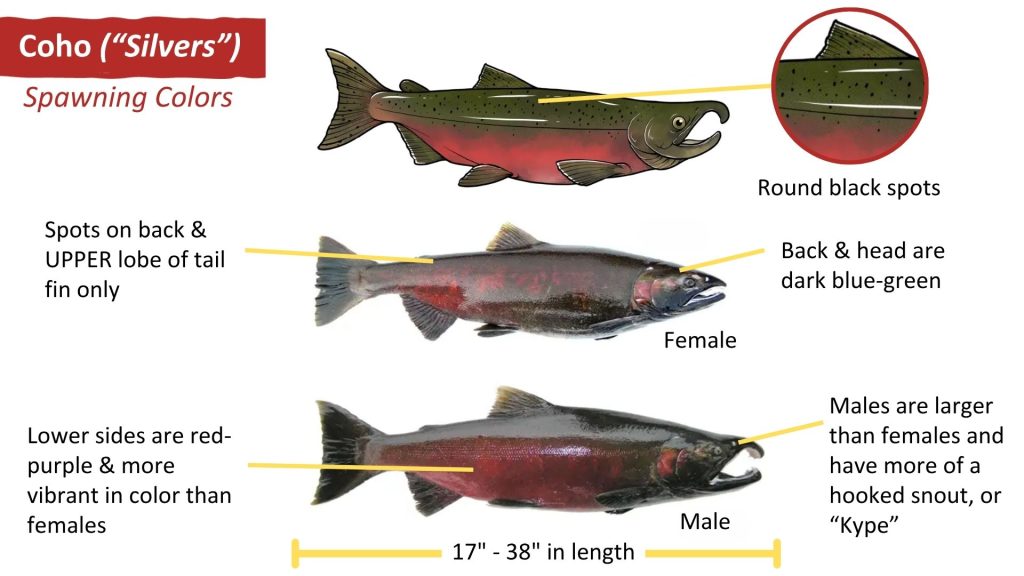
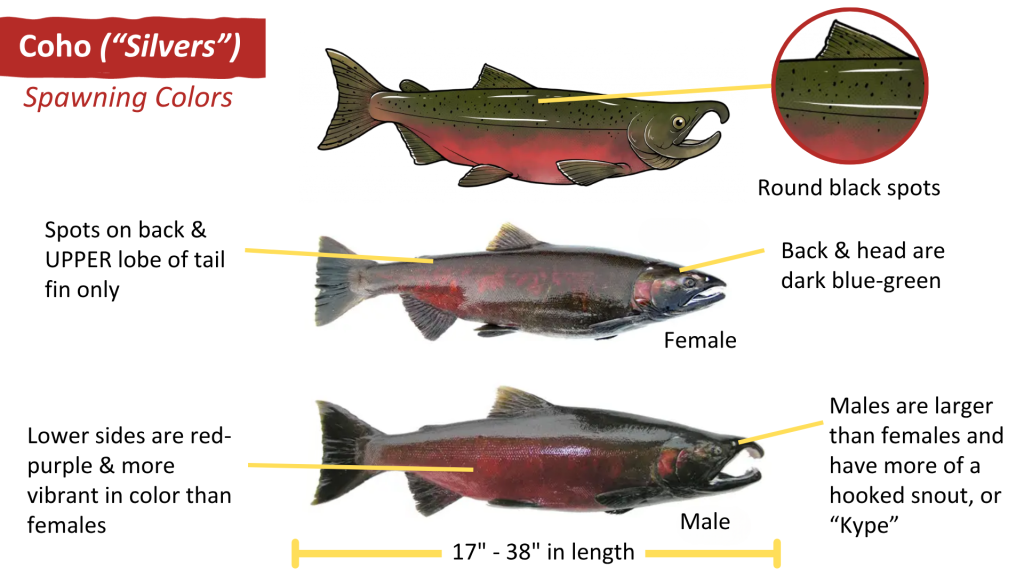
We’re pretty used to spotting coho in the stream by now, with their spots along their dark blue-green backs, dorsal fins, and tails. Males and females can sport the red-purple color, with males more vibrant than females. These fish are smaller then chum, clocking in at 17-38 inches. At Miller-Walker Creeks this year our dead coho have an average length of 23 inches.
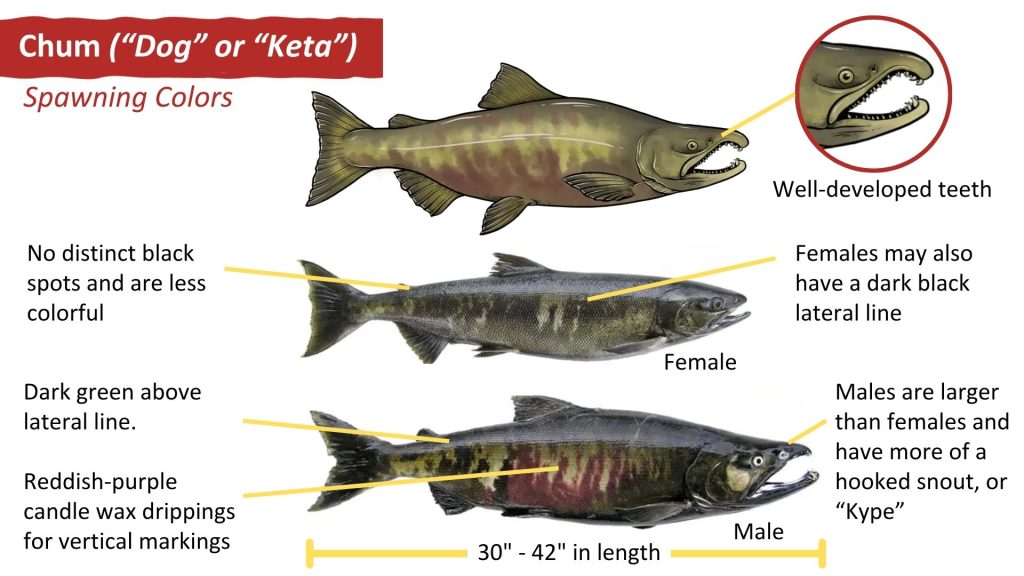
Our chum are larger, with dark green/brown and olive scales with reddish-purple candle wax drippings along their sides. These tiger stripes of color are more prominent on the males, although females can have them as well – just less distinguished. Females male also have a dark bar that runs along their lateral line. The males will sport large, well-developed, teeth, similar to a small canine. They use these teeth to bite and grab at other males when sparring over a female.
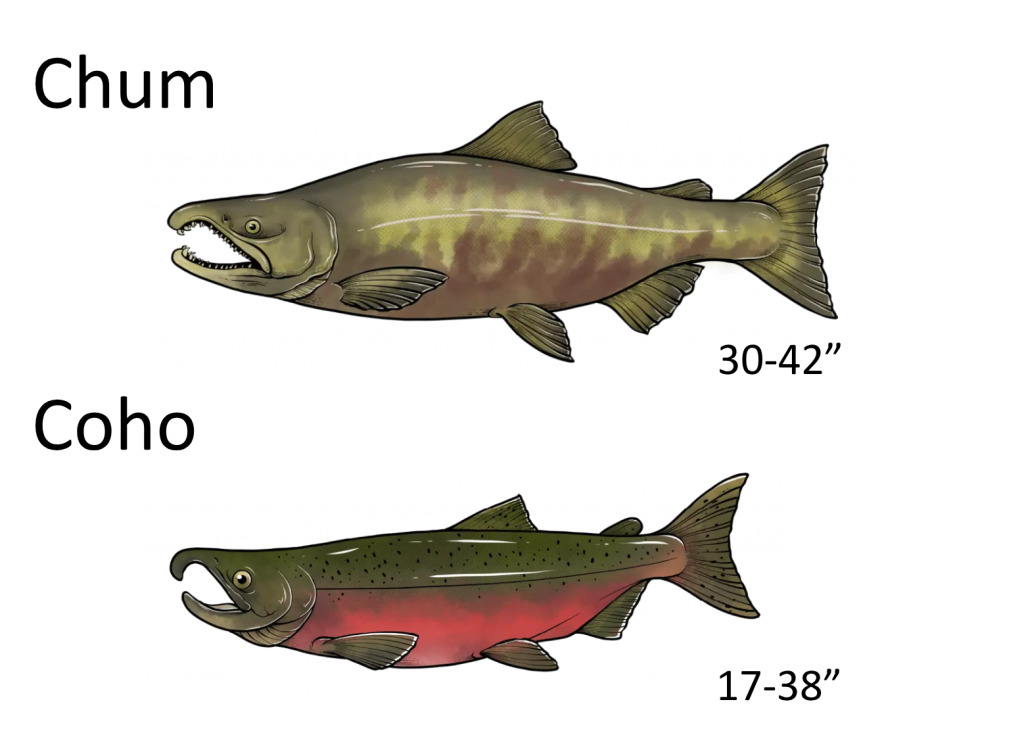
Graphics from Pacific Wild
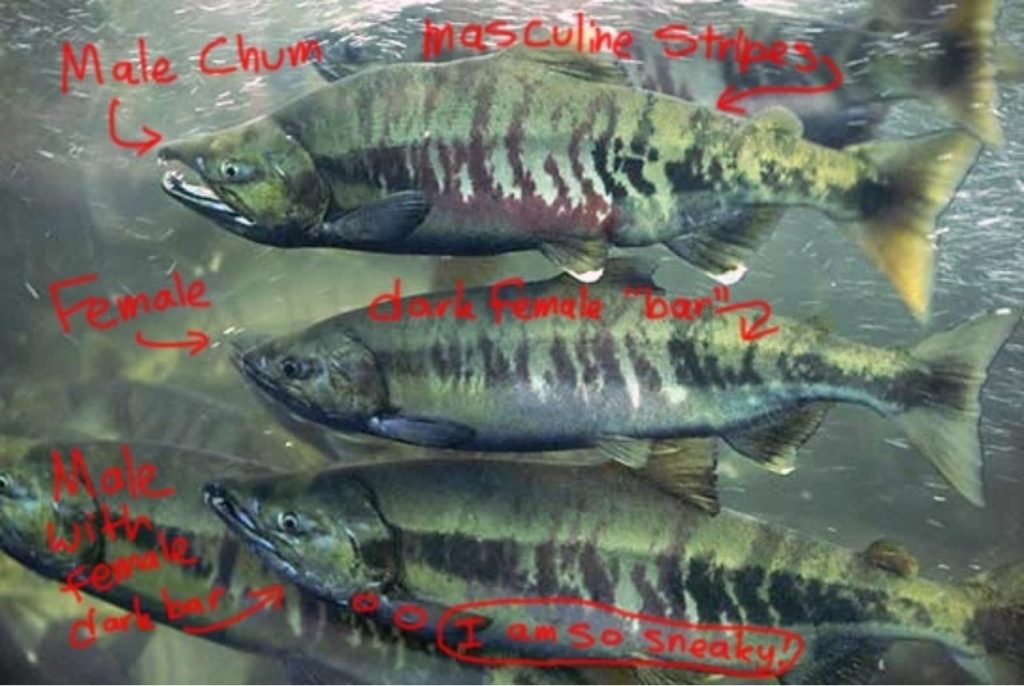
Sneaky Chum!
You may notice though that nature doesn’t always follow the strict identification rules. On the left you’ll see two male chum, and one female chum. The top male shows the distinguished candle wax drippings or tiger stripes of reddish-purple, while the male on the bottom sports a more distinguished black stripe along the lateral line, similar to the female chum in the middle. However, both males have distinctive kypes, or snouts, with large teeth and eyes. They are also physically larger than the female chum. She differs not only in size, but she also has a more rounded head shape with teeny tiny teeth and a smaller eye.
Now that you know a little bit more about how to identify coho and chum, keep an eye out for these two different salmon species at Miller and Walker Creeks!
What are "Redds"?
What is incredible about the 5 species of Pacific salmon is that each species utilizes different stretches of the stream for spawning. For our smaller stream system, coho and chum may compete for spewing habitat since it is fairly limited in these urban streams, increasing competition.
Females will choose a site for her redd, or nest(s), that is in moving water with gentle riffles, approximately two feet below the stream surface, and with a mixture of gravel that ranges in size from a thumbnail to silver dollar. This redd can contain more than one nest and she’ll be able to deposit a percentage of her ~3,000 eggs into one or more nests over several days of spawning. Her eggs can be fertilized by one male for all of her nests, or different males for each nest in the redd.
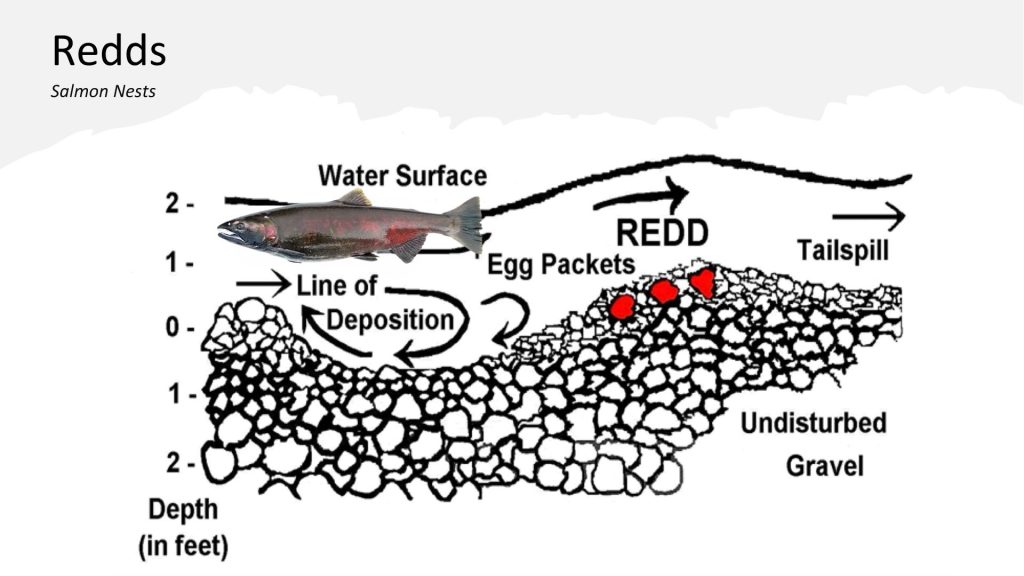
To the left is footage the Mid Sound team captured of two males sparring while a female coho digs her redd. You’ll also see the main male (he’s missing a chunk out of his tail), chase and nudge at a fresh male entering into the duck pond from the Sound. You’ll see the female turn on her side and slap her body up and down, working to remove sediment from between the gravel. Similar to a silty or clay-rich soil, oxygen cannot bubble through the tightly packed particles so the female clears this out to make room for her eggs. This space will keep the eggs from suffocating in the silt. Her undulating movement also dislodges smaller pieces of gravel that will move downstream, forming what’s called the “Tailspill” (see graphic above), washing away the finer sediment. She will keep working on her nest until it measures ~12 – 18 inches in depth.
As the female coho digs, her movements will signal to passing males that she is getting ready to lay her eggs. Males will proceed to fight off any other males, nosing them out of the way, chasing them, nipping at their tales, and raising their dorsal fins in an act to showcase how large they are. In between fights, the male will dance slightly behind the female, weaving his body over the lower half of hers. Part of this dance may also include moving alongside her and quivering, before returning to his courtship dance: weaving around her dorsal and caudal fins. In the video above you’ll also see him widen his mouth into a “gape” and nudging her in his display. The female will continue digging while the male dances and fights off the competition until she feels the nest is ready. She’ll then open her mouth to reduce the impact of the water’s current, helping her “crouch” deeper into the nest. When she does this movement it will signal to the male that she is getting ready to release her eggs. Side-by-side the spawning pair will quiver their tales and open their mouths wide a they release the eggs and milt (sperm) into the nest.
The female will then move upstream to build her next nest, the gravel from the second nest lightly covering the eggs in the first nest, protecting them form being washed away during water fluctuations. This digging process will continue until the female has released all of her eggs, and she will stay near her redd defending it from newer females looking for a nice home for their eggs. She’ll protect her redd until she grows weak and is swept downstream or until she dies. But this ins’t the end of the story.
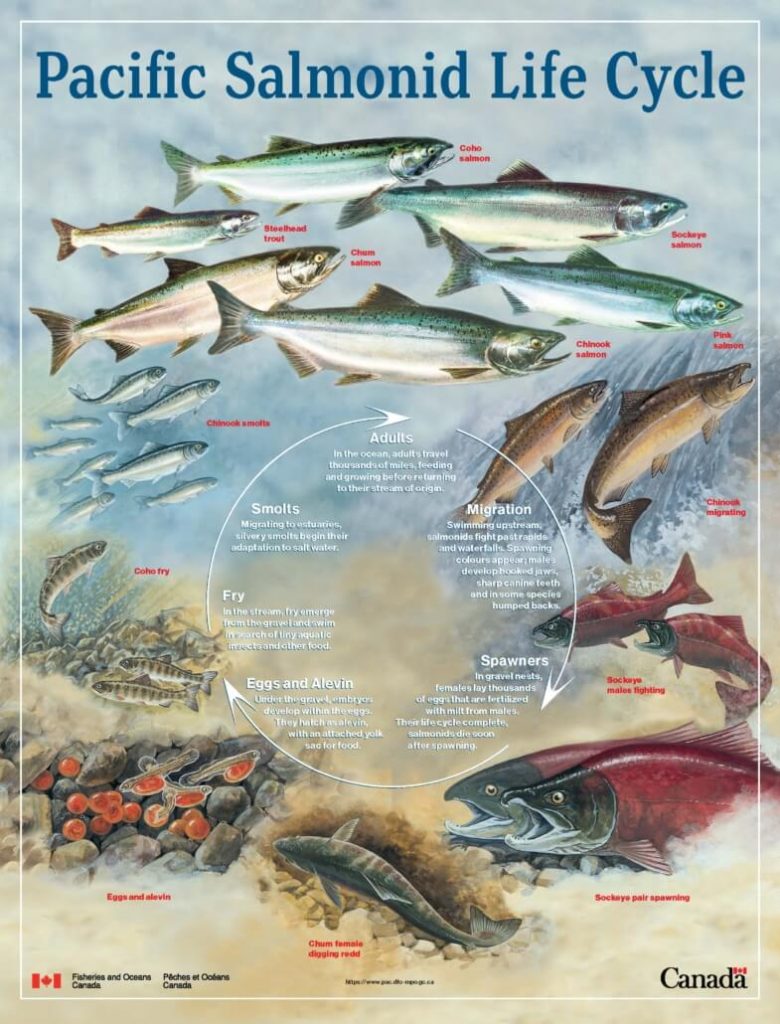
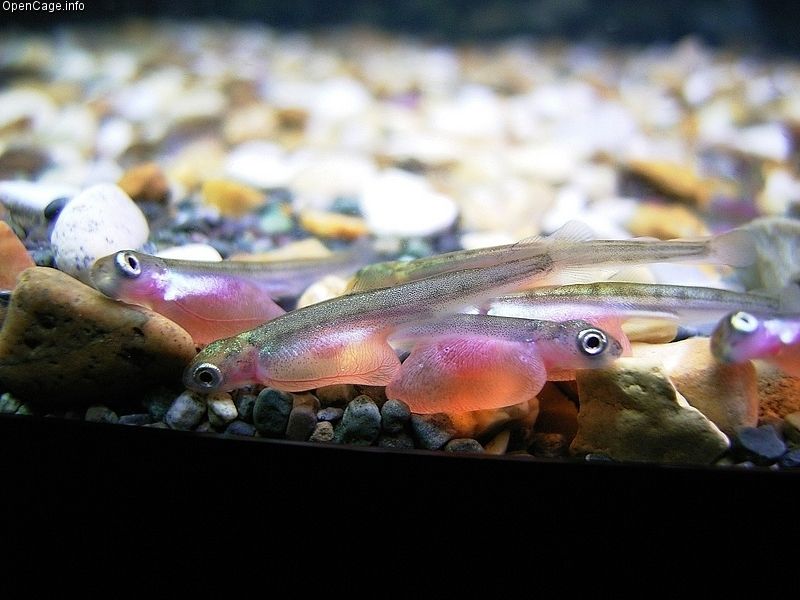
Her eggs will hatch over the next few months, emerging as alevin with their yolk sacs still attached the their abdomens. After the yolk sac is absorbed the alevin will morph into fry, spending the first year of their lives in the streams. They’ll spend this year foraging and growing to be big enough to venture out into the Sound as smolts. Here they will live for the next 2-4 years before returning to their home streams.
This development process is why other species, like the beaver, are so important to the salmon’s survival. Turbulent flows can push fry out to the Sound too soon, or can suffocate them with too much sediment washing off from nearby homes and roadways. As we learned last week, the beaver dams slow the water flow and reduce turbidity, creating healthier steam systems for the young fry. More fry surviving to adulthood, allows this incredible life cycle to continue.
Stormwater's Deadly Impact on Salmon
Within the past couple of decades we’ve learned of the deadly impacts of stormwater on salmon, specifically coho. Urban runoff carries with it a myriad of pollutants that are harmful to our watersheds, including the deadly 6PPDQ (a byproduct from tires) which is responsible for killing up to 90% of coho returns annually. Just a few drops of this concentrated poison is enough to kill all the salmon in two (2) olympic-sized swimming pools.

Urban runoff not only carries pollutants, but also a large amount of fine sediments, and a crushing flow of water that has the power to completely rearrange stream systems. Sediment is deadly to salmon eggs that need cold, clear, clean, and oxygen-rich water to survive. When eggs are covered with fine sediments from our roadways, reducing oxygen flow, the eggs suffocate and die. Water flow in urban streams can be powerful enough to scour out the bottoms of streams, uprooting salmon redds, flushing away eggs and alevin, and destroying the homes of the aquatic bugs salmon feed on. This extreme flow is due to stormwater water bypassing a critical step in the water cycle: percolation. Percolation is when precipitation is able to percolate through soils, and other pervious surfaces, into the water table. In urban systems, the majority of the ground is covered with impervious surfaces like roads, sidewalks, and roofs. This allows water to skip percolation and instead gush down into streams at alarming rates.
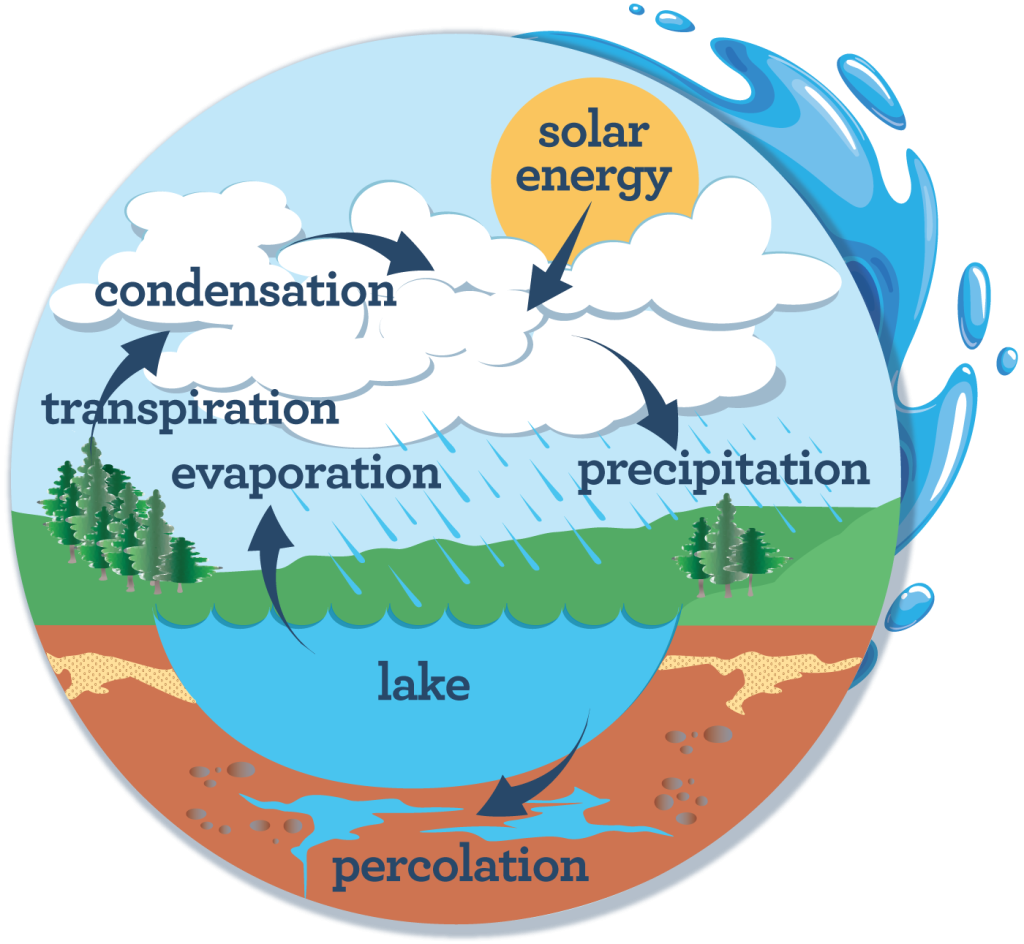
Graphic from WaterMatters.org
The Urban Beaver: A Stormwater Management Expert
Beaver dams in a stream system not only help reduce sediment loads in water, but also decrease deadly water velocity – creating the perfect habitat for salmon to thrive. Slower water cannot hold large amounts of sediment so with each dam stormwater hits, the water becomes clearer and slower. Juvenile coho, who spend the first year of their lives in streams and estuaries, need clear water to locate hiding places and to hunt, and need slower water so they aren’t flushed out into the Sound before they are big enough to survive open water. Beavers also introduce more large wood into the stream through trees they have felled which in turn capture woody debris floating down streams. These pieces of wood create pools in the streams which are essential hiding places for salmon of all ages to rest, and for juveniles to forage and hide.
But wait, if there are dams in the stream, how do salmon navigate the water without getting trapped?
Salmon and beaver have been evolving alongside one another for thousands of years, even before the first humans arrived 10,000 years ago. Young salmon are small enough to slip through the cracks in the dam, while adult salmon are strong enough to break through them, or swim around them. Along some dams, water may spill around the sides of the dam, creating small side channels that spawning salmon can easily swim up.
In the video below, chum salmon work together over the course of a couple days to make a small opening in the dam so they can pass through. What’s amazing about this opening is that it is below the surface level of the water, which means it does not create a cascading waterfall. When beaver hear the sound of rushing water over their dam, they will immediately fix this area to hold back water. This is because the deep water protects them from predators like coyotes, wolves, bears, and mountain lions.
Thanks to the beaver who lives in the Miller-Walker stream systems, and the humans who help beaver and people coexist, creating improved habitat for salmon in this urban area.
Week 3

Week 3: October 16 – 22, 2026
Folks, I wish I had good news for you this week but this drought is creating some hardships for coho around Western Washington.
Week three has been another record setting dry spell (second driest October on record) that is not only impacting fish returns in the Miller & Walker Basin, but has impacted coho returns across Western Washington. In April 2026, the Department of Ecology declared a state-wide drought and we’re seeing it persist 6 months later. The Seattle Times reported that conditions here are currently drier than Las Vegas and Phoenix, and WDFW has closed fishing in many of the rivers nearby including on the peninsula due to low water conditions and poor coho returns. WDFW’s Coastal Region Fish Program Manager, Chad Herring, was quoted on October 21st:
“Drought conditions are impacting salmon migrations and causing serious conservation concerns. To ensure enough fish make it to their spawning areas, WDFW is closing recreational fishing on several major rivers until flows increase or salmon monitoring information suggests they are successfully migrating upstream. This necessary action supports Washington’s salmon conservation goals and future fisheries.”

Headline from The Seattle Times on Tuesday, October 20th.
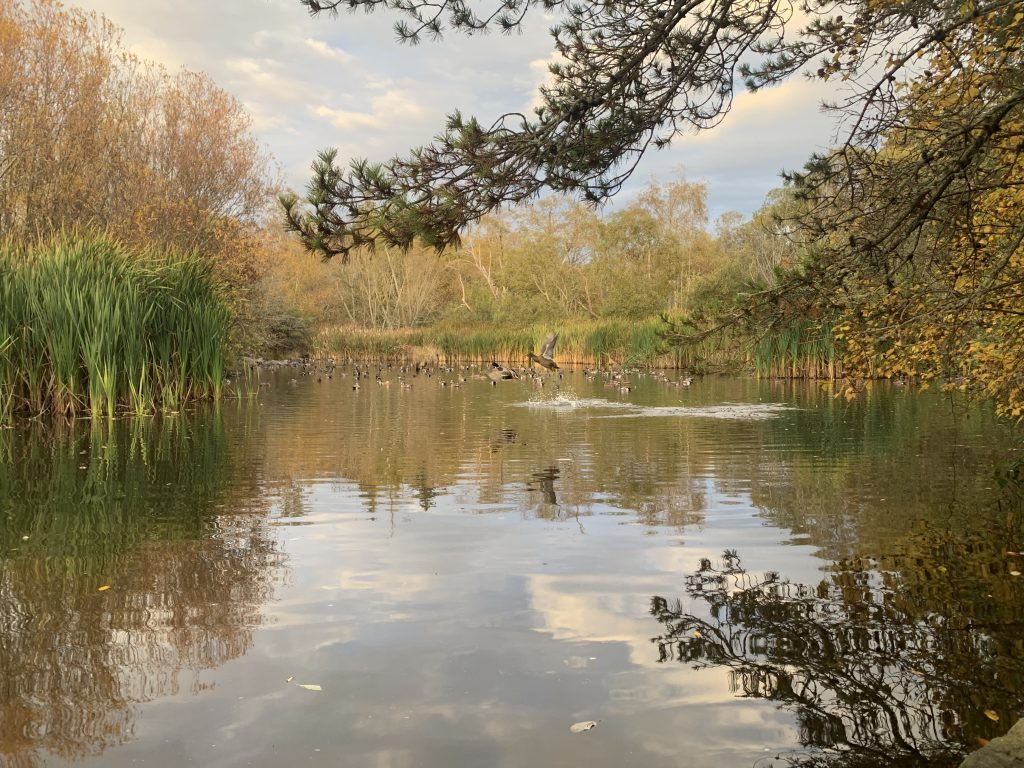
Ducks standing in the Duck Pond at The Cove on October 22nd where water is currently too shallow due to drought for salmon to navigate upstream.
These closures not only impact the health of the watershed and the 137 species who depend on salmon for survival, but also the people and Tribes who depend on this resource. While we are forecasted to have some rain this next week (~0.6″), it is still not enough to encourage large quantities of salmon to return home. As CSI volunteers have been walking the streams, they’ve been reporting daily low-flows in both streams. They’ve also reported that the Duck Pond on Lower Walker is still too shallow for fish to navigate – water is only a couple of inches deep – with ducks able to sleeping while standing in the middle of the pond. It’s also been warm! Warmer days equals warmer water, warmer water means that fish are expending more energy to navigate streams, stressing them out and leaving them at higher risk to toxins (such as 6PPDQ), as well as bacterial and fungal infections.
We saw last year how climate change is beginning to impact the seasons here in the PNW, with longer stretches of warm days starting earlier in the season and ending later, and less rainfall and snowpack in the fall and winter. When it does rain here in the Puget Sound lowlands, it’s predicted to be shorter bursts of intense rainfall (i.e. the back-to-back bomb cyclones of December 2025 that scoured out streams across Western Washington, and flooded most of Auburn). This year we’re still seeing the impacts of climate change and how these effects are exacerbating the conditions from an El Niño year. We already saw poor snowpack last year and it’s projected to be worse this year due to El Niño. Why should we care about snowpack? This is what helps feed our rivers and tributaries, provides drinking water for cities, provides water for agriculture, and recharges groundwater.
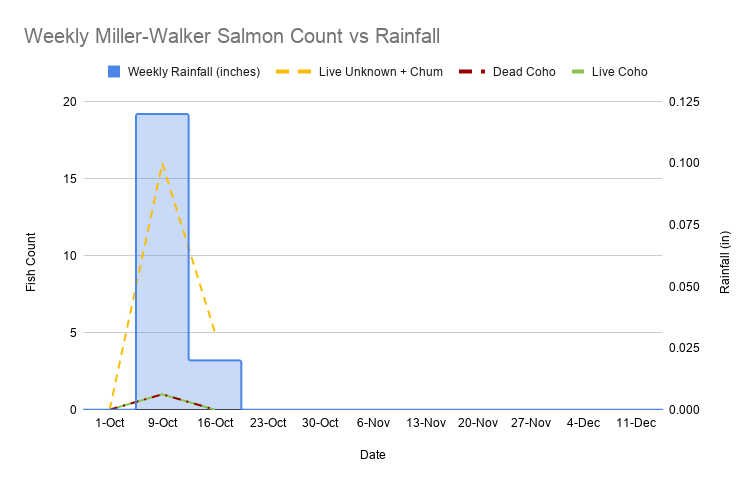
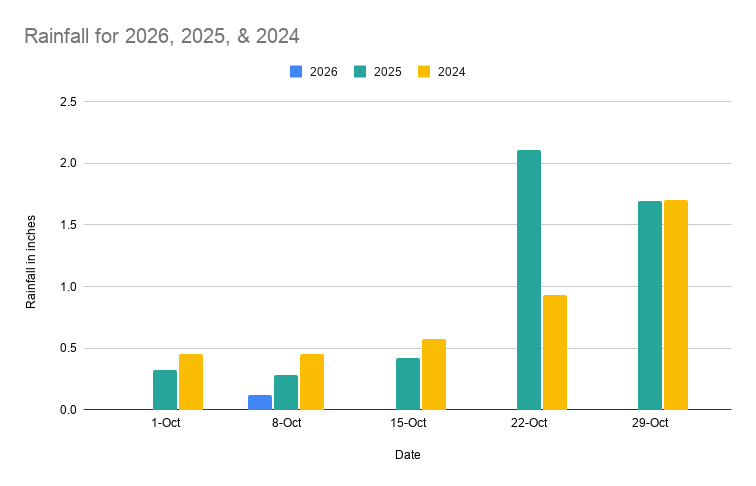
Rainfall vs number of salmon observations in Miller & Walker for 2026.
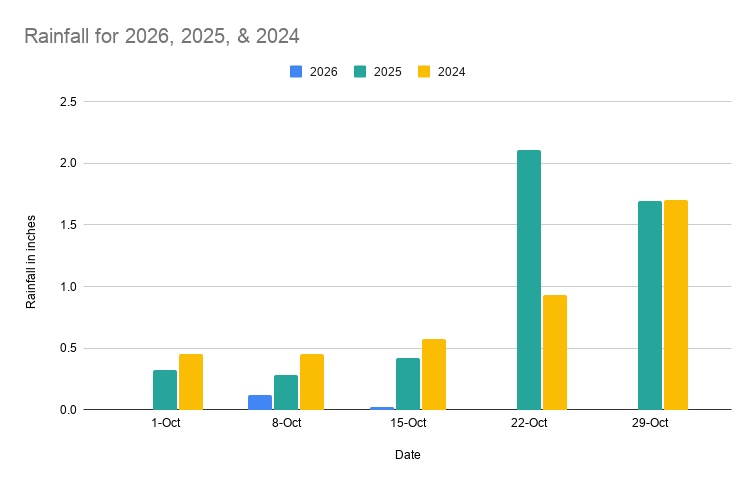
The amount of rainfall for 2026 in the blue column shows the deficit of water in the system compared to 2025 & 2024 (both considered “dry” for October).
So what does this mean for the salmon survey this year?
We’re going to find out! So far we’re not seeing a lot of fish in the system. At most 6 coho have been seen in the Duck Pond, but survey teams on Wednesday and Thursday reported seeing zero fish in the Duck Pond. They could be hiding, they may have been dinner for the otters, or they may have died. Once in the freshwater system, even one with tidal exchange (meaning salt water is able to flow into the system during high tides), coho only have about two weeks before their bodies start to decompose and they die.
As volunteers walk the stream, I encourage you all to be extra diligent when looking for fish. I walked Lower Walker and Lower Miller stream Thursday evening and after standing along the bank at the confluence of Lower Miller and Lower Walker for a couple of minutes I spotted a lone coho swim up Lower Miller. A few intrepid fish are venturing into the stream so take an extra beat or two to watch for them.
Salmon Counter - Week 3
Week 2

Week 2: October 9 – 15, 2026
Welcome home to the coho salmon! We’re starting to see a handful of coho salmon in the duck pond. And while we know the salmon are in the Sound, they are waiting to enter the streams until it rains. Volunteers have noted incredibly low stream levels, with portions of the stream exposed, leaving small, shallow flows for fish to navigate.
As we learned last week, rain allows salmon to safely enter the stream with high flows of fresh, cold, water that keeps them oxygenated, and creates deep pools to rest in and hide from predators. Low water is dangerous to fish – it can be warmer, more difficult to navigate, and leave them exposed to predators. Warmer water means less oxygen and causes salmon to exert more energy, leaving them susceptible to exhaustion, bacterial infection, and predation.
Unfortunately there are no rains on the horizon, with more days of sunshine with temperatures in the upper 50s projected to the end of October. This may be great news for humans hoping to squeeze some more dry outdoors time, but for the fish this means the salmon in the duck pond are literal “sitting ducks” for predators (especially the river otters), and we may not see any new fish enter the streams until we move into cooler, wetter, weather.
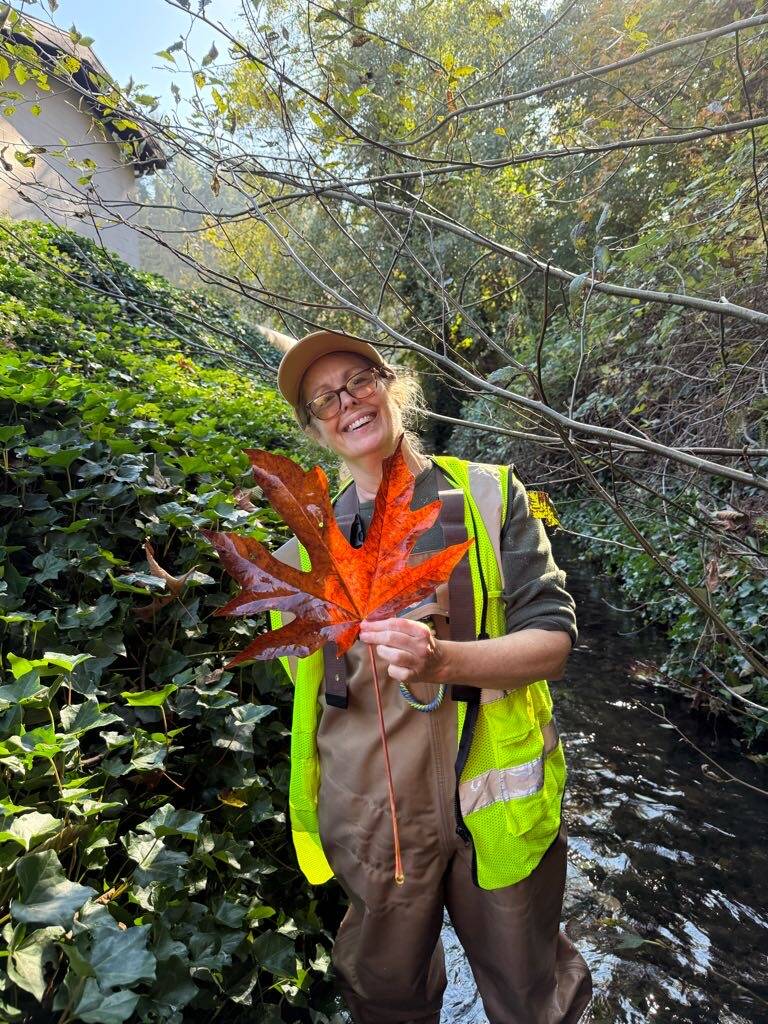
Carol from Thursday Team A poses with a large leaf maple leaf in full fall color. Photo by: Ava B.
Salmon Counter - Week 2
How to Identify Coho Salmon?
As we see the coho begin to return we are looking for specific characteristics to help us identify them:
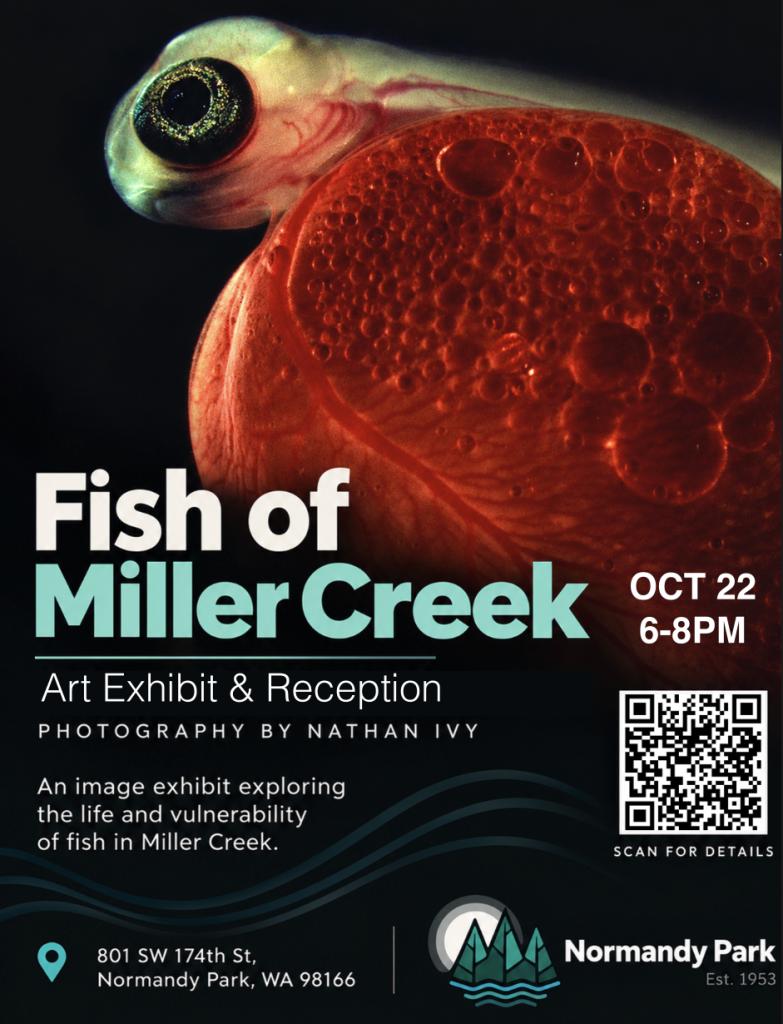
Join Us for Nathan Ivy's Upcoming Art Reception
Explore the intersection of science and art in a special exhibition featuring the scientific work of researcher Nathan Ivy, including work connected to the salmon CSI study at Miller/Walker Creek. The exhibit offers a fascinating look at salmon research and the science happening right here in our local community. The event will begin with a brief panel presentation, followed by an open house-style reception.
Donations from the nonprofit 501(c)(3)s Friends of Normandy Park Foundation and Trout Unlimited helped fund a portion of the materials and this event.
Event Details:
Thursday, October 22nd | 6pm – 8pm
Normandy Park City Hall
801 SW 174th Street, Normandy Park, WA 98166
Week 1

Week 1: October 1 – 8, 2026
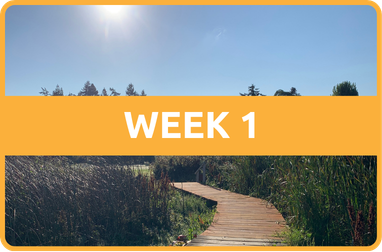
Similar to last year, the start of October has brought day-after-day of blue-bird skies and afternoons filled with warm sunshine. This start to the salmon season has been dry, with only a couple days of rain sprinkled in. We learned last year that a dry start to October equals a slow start to salmon returning home. Salmon depend on the cold, fresh water that fills the streams with fall storms to signal to them that it is safe to leave the Sound and enter back into the streams. If they splashed home before the rains, they would find shallow stream beds with warm water – both of which are inhospitable for spawning salmon and would leave them vulnerable to predators.
Salmon depend on the 5 “C”s for survival: Cold, Clear, Clean, Connected, and Complex. Cold water means more dissolved oxygen for salmon to breathe as they swim upstream to spawn. Clear and Clean help salmon safely navigate streams systems while staying free of bacterial infections and deadly encounters with toxic stormwater. Connected allows salmon to navigate from the Sound to spawning beds upstream, free of any passage barriers like culverts or man-made dams. Complex means that streams are curvy, filled with large woody debris to offer socur pools to rest in, riffles to spawn in, and shade to protect from heat and predators.
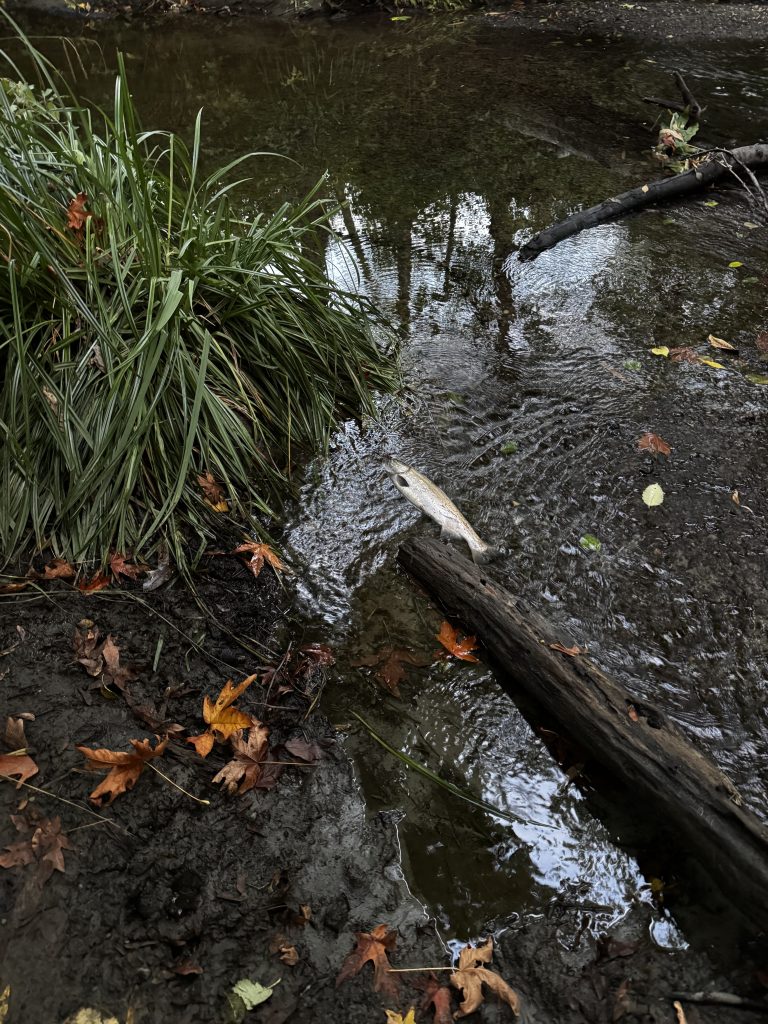
Early rains in late September encourage a lone coho to enter Lower Miller. Unfortunately this fish died of Urban Runoff Mortality Syndrome (URMS).
Why aren't there more adult salmon in the stream yet?
Right now we just haven’t had enough rain to fill up the streams with a consistent flow of cold water. Looking at last year, our first week of October registered 0.00″ of rainfall in the first week. With scattered showers projected for 10/17 – we’re looking a dry start.
Hopefully rains will come soon and welcome more salmon home!
Updates for Volunteers:
Now that the salmon have returned, please make sure you are filling out both Epicollect forms:
- CSI Salmon Survey Notes
- Salmon Survey Fish Log Miller Walker
- *** This is a new log for 2026***
There are also data forms in your clipboards if you run into any technical difficulties with Epicollect. Please take a photo of your completed data form and send to Piper via Slack or Email.

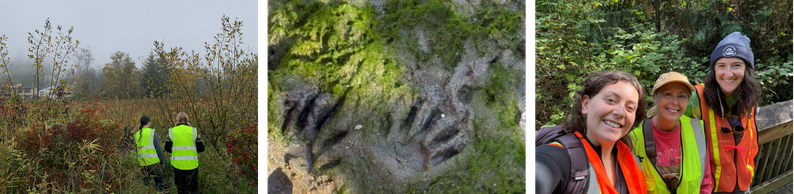
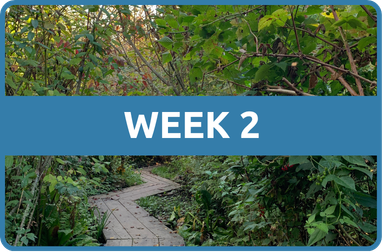
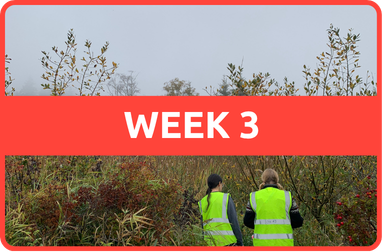
Photos L to R: Monday Team A looking for salmon in Lower Walker; Raccoon footprints in mud on Lower Miller; Thursday Team A stop for a selfie on Lower Miller.
Salmon Counter - Week 1
Who are we seeing in the stream right now?
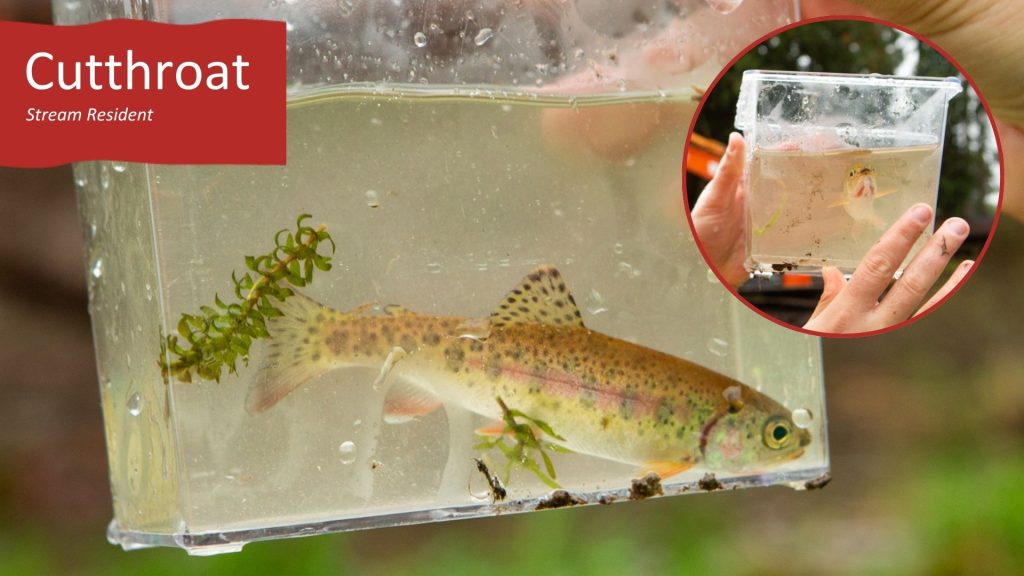
Volunteers have been reporting seeing tons of tiny salmonids (fish in the salmon family) in the stream. But who are they? In both Miller and Walker we have juvenile coho (oncorhynchus kisutch) who spend the first year of their lives in the streams. We also have resident cutthroat trout (oncorhynchus clarkii) – which are part of the salmon family. When you’re out in the stream, these fish are easy to confuse as they have similar markings that allow them to camouflage perfectly with their surroundings, and they dart quickly to shadowed areas for protection when they see us, or other predators, approaching.
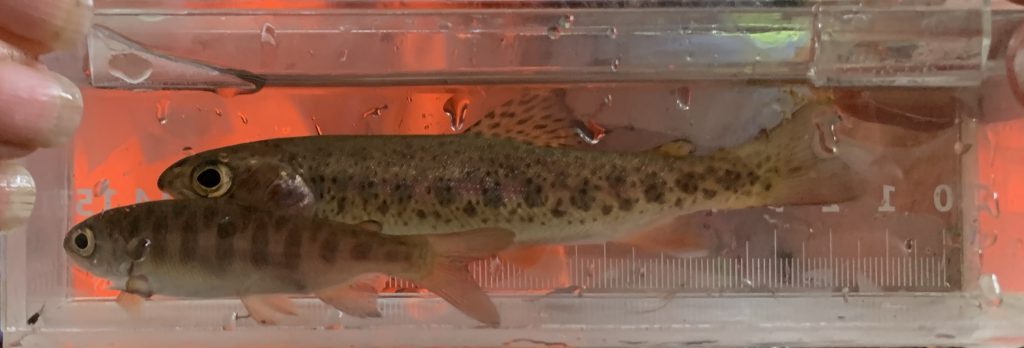
Above are a juvenile coho (front) and resident cutthroat (back) side by side for comparison. Listed below are the main distinguishing features between these two fish:
- Juvenile coho are 2 – 3 inches in length and have par marks (dark, oval, markings) on their sides as well as their backs, with pale orange fins. Their anal fin is more sickle shaped (with a white stripe along the edge), and their mouth does not extend past their eye.
- Cutthroat are 5 – 8 inches in length. They also have par marks along their lateral line, but they also have spots along their sides and backs, including up into their dorsal fin and down into their caudal fin (tail fin). They are pale yellow-green in color and have an iridescent sheen to their scales in sunlight. Their mouth extends past their eye.
- Bonus Fact: Cutthroat get their gruesome name from the orange-red slits on the underside of their jaw.
Thank You to Our Partners
This program is possible due to the support of a number of partners and volunteers. We could not do this work without your support. Thank you!
